
Artificial Maturity and the Australian Social Media Ban
Children are overexposed to information before they can handle it and underexposed to real-life experiences. Maybe the Australians are on to something.
An off schedule post
This is an off-schedule post. That means something different or interesting is going on that warrants paying attention to. So, my friends, read on to find out more!
Timing is everything
I often emphasize the importance of proper timing for success. We usually control the timing of what we do. Then again, sometimes it just works out that everything comes into place at the perfect time without any input from us. Call it luck, fate, or what have you. In any case, we need to recognize when to time certain situations for a successful outcome. I’ve written and taught about this because a key to achieving your dreams and living your best life is being successful in your endeavors. You won’t be successful in all of them; we all fail or mess up occasionally, but your goal in reaching your dreams is to succeed in the big decisions. I’ll ask you to ponder if you have learned the importance of event timing in your life. If you are not sure what I’m talking about, consider taking the course or purchasing my book (Note 8) to learn more.
One time, Diane and I were in London. We love all things UK, and London is a world-class city in every respect. In this case, we traveled to London to see The Phantom of the Opera at its original venue, the London Theatre (Note 1). The London Theatre is the original venue for The Phantom, and it has played continuously since its 1986 debut. If you ever have a chance to go, it’s a real treat. We had previously seen the Phantom in New York City and Tulsa (twice). I’d like to see it in Vienna, Austria, that would be really cool…When it came to Tulsa the first time, it was a really big deal. They had to cut a hole in the roof of the Performing Arts Center (PAC) to install the chandelier, and construction workers also had to reinforce the roof structure to support it. If you’ve never seen the scene of the chandelier crashing down, click on the link in Note 2 to watch it. Seeing this scene in person sends chills up your back!
In case you don’t know it, the Phantom is based on a novel by Gaston Leroux and set in the Paris Opera House (Palais Garnier in French) in 1910. The Paris Opera House is a popular tourist spot, and besides the stunning architecture, there is the famous Box 5, the Phantom’s private box. It has a poor view of the stage but a good view of the crowd, and is often kept empty now. If you are ever in Paris, it’s one of the many must-see attractions. Hint: Like everything in Paris, buy your tickets far in advance. The photo you see is the one Diane took when we were there in May 2025.
Trivia question: What is a candle maker called? Answer: A chandelier! Now you know!
Alas, I digress…I was talking about timing. During this particular trip to London, we stayed at a boutique hotel in the Westminster section of London. Westminster (Note 3) is a city within London and a great place to stay to see most of the sights tourists want to see. We were able to walk to the theatre. We also walked to another place I wanted to see, through St. James Park (a nice walk in itself), The Churchill War Rooms (Note 4). This is a secret underground headquarters where the British conducted World War II operations. It’s really cool. While we were standing in line to get in, we noticed a courtyard to our left, off The Horse Guard’s Road. An obviously important entourage of cars enters the courtyard. We went into the museum but vowed to check it out after our tour. So then we did. Turns out this was Prince Charles and his staff, we were told, apparently coming to watch a parade that we just happened to stumble upon at…10 Downing Street. Yes, that 10 Downing Street, the official residence of the Prime Minister of the UK. And we arrived just as they were closing the gate to the courtyard, and the annual Victory in Europe (VE) Day parade was about to begin. This is an awesome event and a real privilege to watch, especially in person.
Think about that for a moment. Two Americans stumble upon a VE Day parade in London and, not only find a place to stand and watch it but also do so in front of 10 Downing Street just before it begins. Interestingly, throughout our travels over the years, given how well Diane plans our adventures, we continue to find amazing things just like this one we stumble upon. Yes, timing is everything.
One more short story about London and timing before we move on. On the same trip, we decided to cross the River Thames and see and ride the London Eye Ferris wheel. Again, staying in Westminster means many of the things you want to see are within walking distance, or certainly a quick ride on the tube (the slang for subway). After a fantastic ride and view of the city, we decided to cross back over the river and walk to St. Paul’s Cathedral. While we were walking, motorcycles and cars suddenly screamed by, pulled over, and observed the people along the road very carefully. It was obvious something was going on, so we stood there and waited to see what it was. Sure enough, a minute or so later, here came the Queen who had just attended mass at the church. We saw her briefly through the window of her car as they sped by and the motorcycles and others in her entourage took off to secure the next mile.
Yes, timing, whether by planning or luck, is everything. For us, the old saying “I’d rather be lucky than good” often rings true when it comes to things like this.
Artificial maturity
And so it is that my latest read is a book called Artificial Maturity (Note 5), about children who are overexposed to information at an earlier age than ever yet underexposed to meaningful relationships and real-life experiences and the consequences of such. We’ll get into this book in a minute, but, as good timing would have it, just the other day, right as I started the book, the country of Australia banned social media for children under age 16 (Note 6) with the hope of improved family life, reduced exposure to harmful content, and other projected benefits, and many of the issues discussed in the book. Children have been urged to “start a new sport, take up a new instrument or read a book.” Timing is everything.
The book was written in 2012, so it’s a bit dated. Still, in my opinion, the theory that children are challenged to become authentic adults in today’s digital age is probably more acute in 2025 than it was in 2012. I’d like to recommend you read it (click on the link in Note 5 to get a copy) so you fully understand the issue. For now, I’d like to highlight a few of the key points the book makes to pique your interest (again, see Note 5):
The artificial maturity dilemma can be described as children being overexposed to information far earlier than they are ready and, conversely, underexposed to real-life experiences far later than they need to be.
Interestingly, these concepts were known to the ancient Greeks as ginosko (informational knowledge)-to be aware of; to be informed; to be familiar with, and oida (experiential knowledge)-to fully perceive and understand through experience.
Many parents today, while well-intentioned, are part of the problem: we hover over them, monitor their lives, and structure every moment of their time.
Measuring children’s maturation generally involves four aspects:
Biological-physical growth
Cognitive-Intellectual growth
Social-interactive (skills to interact positively with others, build relationships and understand social cues)
Emotional-intrapersonal (developing self-awareness, emotional intelligence and self-regulation)
Dr. Smith attributes the high amount of artificial maturity we have today to eight basic reasons:
High school-Since the 1920’s, children have more and more often been segregated into age-related groups, interacting mostly with peers instead of a wide range of different-aged students (Author’s note: This trend seems to have accelerated in recent years, with some schools consisting of a single grade, such as 9th only).
Video games-The author shares research relating that time spent on video games is inversely proportional to good grades. In other words, more time spent on video games results in poorer grades. Besides harming grades, increased video game use breeds false confidence in children and an inability to engage with the slower-paced reality of the real world.
Prescription drugs-We tend to over-medicate kids instead of being creative in dealing with them. The result is kids who lack ambition and are lethargic.
Parenting styles-we hover over our kids, protecting them from any harm. We’ve removed the need for kids to self-regulate, resulting in more protection than preparation for adulthood. (Author’s note: Ever heard of a helicopter mom? How about lawn mower parents? Look them up…)
Endocrine disruptors-BPA and other chemicals in plastics are entering our human systems. Some research suggests chemicals may speed up puberty but postpone internal maturation. (Author’s note: concerns about microplastics are growing and becoming more public in recent years.)
Teaching methods-we seem to be more conditioning students to be passive, take notes and regurgitate data for a final test rather than participatory. In short, kids are passing but not learning.
Niche marketing-more and more children are subject to targeted marketing, increasing prolonged adolescence. One result is more children moving home after college (Author note: See Note 7, Failure to Launch Syndrome. I also recently wrote about my experience in reduced learning with the advent of the computer and reduction in books in the classroom.)
Media and technology-results in instant gratification and results. If something takes too long, a student can delete it, stop it, block it, or turn it off. None of this is like the real world.
Yikes! Dr. Smith goes on to describe what he calls a false confidence in adolescents, something psychologists refer to as “high arrogance, low self-esteem,” which is common in those with the world at their fingertips (read: smartphones). Double Yikes!
You know, it’s never good to generalize or stereotype. In this case, because we know the situation is not true of all youth today. I’ve had the privilege of working with some incredibly motivated and intelligent high school and early 20s students at Tulsa Technology Center, where I substitute teach, so I know not everyone fits the category of suffering from artificial maturity.
That said, given the advancements in technology since 2012 and the coming-of-age of Gen Z, I just gotta say…Yes, I see this everywhere, and I’m concerned about it. I think Australia is on the right track and is leading a charge I hope others adopt.
Think about this: How many kids have you seen walking from, or standing at, the bus stop without having their face in a phone? And it’s just not young adults. Look around when you are at a red light, and what do you see? Yes, everyone is looking at their phone. On an airplane? Waiting in the doctor’s office? While artificial intelligence is a young adult thing, overuse of technology is just a thing for everyone. At least in the “World According to Dave.”
What do you think?
Summary
The world is waiting to see if Australia was right to ban social media for young children. In my opinion, they made the difficult decision that everyone else knows needs to be made in their own country. And I’ll add that while we probably can’t ban social media for adults, perhaps we need to consider whether we need more self-regulation. Good for Australia, I say. Now let’s wait and see what happens. And who follows suit.
That’s all for this week!
Let’s help our friends and loved ones, shall we?
If you find the information in this post useful or enjoyable, please forward it to those you care about.
Then, simply say, “Search the internet for Afterburner Success Partners
to learn how to achieve your dreams and live your best life!”
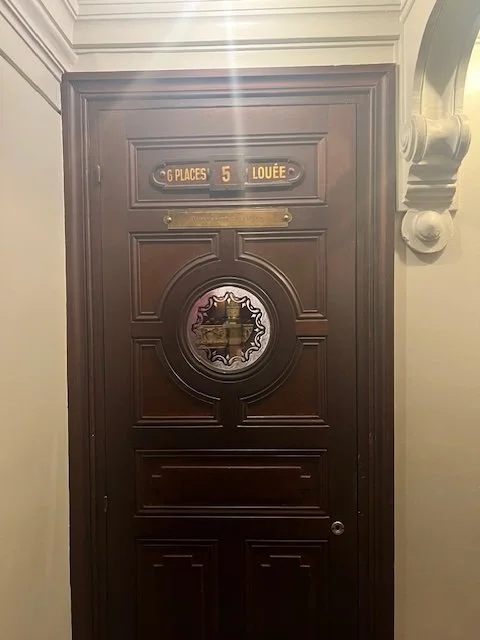
Box 5 at the Paris Opera House
The plaque reads: “Loge de fantome de l’opera” or
“Box of the Phantom of the Opera”
Afterburner Success Partners
What’s in it for Me
The overuse of technology is pretty much a known problem. What can or should you do about it in your own sphere of influence? If you have not established written goals for your lifetime plan and are acting on them, I might suggest taking the Afterburner Success Partner course so we can learn how to prioritize what’s really important to use. Or maybe read the book. Or both!
Call to Action
Purchase the books by clicking on the link in Notes 5 and 8 as mentioned above. Take the Afterburner Success Partners course
Recommended Resources
Buy and read the books Artificial Maturity by Tim Elmore (Note 5) and Achieve Your Dreams: A Complete Guide to Live Your Best Life by David Giustozzi (Note 8).
Up Next
Back to regular posting schedule.
Notes
Please note that as an Amazon Affiliate, I may earn a small commission on the sale of any of these recommended resources.
Chandelier Scene, from the movie, The Phantom of the Opera, 2004: https://www.youtube.com/watch?v=cJKB7XrMrW4
Westminster, Wikipedia: https://en.wikipedia.org/wiki/Westminster
Artificial Maturity by Tim Elmore: https://amzn.to/3L04t6l
Australia begins enforcing world-first teen social media ban, Reuters: https://www.reuters.com/legal/litigation/australia-social-media-ban-takes-effect-world-first-2025-12-09/
What is failure to launch syndrome in young adults?, Newport Institute: https://www.newportinstitute.com/resources/co-occurring-disorders/failure-to-launch-syndrome/?psafe_param=1&utm_source=google&utm_medium=cpc&utm_campaign=NI_performancemax&utm_term=&kpid=go_cmp-17672242732_adg-_ad-__dev-c_ext-_prd-&gad_source=1&gad_campaignid=23095776237&gbraid=0AAAAACWYOxLwKbT6cgcuHU0KOsmBGwuYY&gclid=CjwKCAiAl-_JBhBjEiwAn3rN7TTG3Irdc4QC2Y8BBCRKIDX2MI_VG-zQFhmNB6HL9sS_TFkcaKPe0xoC0pUQAvD_BwE
Achieve Your Dreams: A Complete Guide to Live Your Best Life by David Giustozzi: https://amzn.to/3IxEFgy