
From my cookbook… Dave’s Detroit Style Cast Iron Skillet Pizza
Making pizza at home is tricky, but this one is really simple, a little different, and the results are fantastic!
There are over 300 recipes in my recently published cookbook, Everyday Cooking for Everyday People Like Us (Click on the link in Note 1 to get your own copy). Even in these inflationary times, we can prepare delicious meals for our family and do so in a way that does not break the budget. And it’s all in the cookbook!
Pizza, pizza, pizza and more pizza!
There are many types of pizza around the world, and any list of pizza styles and rankings would be incomplete and, of course, biased toward the tastes of the rater. I’m going to give you a list of what are likely the eight most popular in the United States, and then add one you may not have heard of. Not surprisingly, many of them are named after cities, some after regions or countries. Here goes:
1. New York Pizza
2. Chicago Pizza
3. Detroit Pizza
4. New Haven, CT Pizza
5. St. Louis Pizza
6. California Pizza
7. Sicilian Pizza
8. Neapolitan Pizza
9. Old Forge, PA Pizza
When you purchase my cookbook, you will see recipes for four types of pizza: Chicago, Detroit, Italian (Neapolitan), and Old Forge White Pizza. What? You’ve never heard of Old Forge White Pizza? It’s really a Sicilian-style pizza, cheese only, without tomato sauce. There is also an Old Forge Red Pizza, that, as you might figure, includes tomato sauce. Old Forge Pizza is called a tray, as opposed to a pie, and you eat a cut, not a piece. Google it, or simply buy my cookbook for a wonderful story and a delicious recipe for a unique pizza.
Today I feature Detroit Style Cast Iron Skillet Pizza because it’s so easy to make, and if you’ve never made pizza at home, you will get wonderful results very easily, and you will be encouraged to make different styles in the future. Enjoy!
David Giustozzi’s Detroit Style Cast Iron Skillet Pizza
When Diane and I were working demanding jobs, we would be so tired at the end of the week, we declared Friday’s “pizza, beer and movie night.” We would order carryout pizza, stop at the video store to rent a movie (now I’m dating myself) and come home. We’d plug the movie in (originally VCR’s, then CD’s), get a cold beer and veg in front of the movie with our pizza. If it was winter, I’d build a fire in the fireplace for us to enjoy. That would be with wood I had scrouged up, cut up and split. Friday evenings were something we looked forward to!
Making good pizza at home is a bit of a trick. Unless you make pizza for a living, getting the dough right is difficult and you can end up frustrated. The cost/benefit ratio is questionable and there are so many good pizza places that it’s often easier just to order carry out or enjoy it onsite with a nice salad (wedge is the best with pizza!) and have a beer. Then there is the problem of a home oven that is hot enough. Professional pizzaiolos have very hot ovens, often 900 degrees or so. They are often wood fierce and never really cool down.
I like all kinds of pizza! Probably my favorite is traditional New York style with sausage. Just fold it over, take a bite, and you have a slice of heaven. Italian pizza margherita is fantastic. I grew up eating Old Forge, PA style, especially Old Forge White Pizza. Diane and I really like Chicago deep dish and we have to trek to Lou Malnati’s at least a few times a year to get it, or sometimes we just have it shipped, but that’s really expensive. In Oklahoma we have a funky place called Hideaway Pizza. It’s different, but I do like it. Google it for the story.
Then, a few years ago, Detroit style came on the scene with its well-cooked, almost burnt, cheesy, kinda thick crust. A place opened near our home called 313 Pizza. The 313 is the area code for Detroit. So, Detroit style is now on our rotation. This recipe is an imitation of that style of pizza, and it really works. This recipe makes two pizzas, and you will need two skillets to make it. Or you can make one, then the other, but making two at once is best. It’s really simple, but you have to make the dough a day ahead and let it rest, so keep that in mind.
Ingredients
For the dough
2 cups bread flour (King Author preferred)
1 teaspoon yeast, rapid rise preferred
1 cup warm water
1 teaspoon salt
Extra virgin olive oil
For the sauce
1 28 oz can who peeled San Marzano tomatoes (Note 1)
2 teaspoons extra virgin olive oil
3 cloves garlic
½ teaspoon sugar
½ teaspoon salt
½ teaspoon dried oregano (Note 2)
Red pepper flakes (optional)
For the pizza
8 oz. or more Monterey Jack cheese, shredded (Note 3)
14 oz. or more whole milk mozzarella cheese. Not fresh.
Corn meal for dusting the pans
Toppings of your choice, sausage, pepperoni, etc.
Pure olive oil for oiling the skillets (Note 4)
Directions
Whisk the flour, salt and yeast together in a large glass mixing bowl. Add the water and knead until you have a large, sticky ball. Wipe a large glass mixing bowl with extra virgin olive oil, place the dough in it Wipe the top and sides of the dough with more oil. Cover with plastic wrap and place in an oven with the light turned on for two hours, or until doubled in size. The oven is warm and there are no drafts.
Pour some pure olive oil into the skillets to coat the bottom. Sprinkle cornmeal over the bottom of the pan into the oil. The oil will be absorbed into the crust and the cornmeal will help the pizza not to stick and add a very nice crunch to the crust.
Half the dough and place into each skillet and form to fit with your fingers, raising the edges up the sides slightly. Cover with plastic wrap, place back in the oven and allow to rise for about 30 minutes (Note 5).
Make the sauce. Drain the tomatoes and place all of the sauce ingredients in a blender. Pulse until just smooth, and slightly chunky. Pour the sauce into a mixing bowl.
Preheat the oven to 400 degrees. Be sure your skillets are removed!
Remove the cheese from the refrigerator and sprinkle along the walls of the skillet, pressing it in so that it rises about ¾” above the dough and partially transitions to the crust.
Using a ladle, spoon the sauce over the crusts up to about ½” from the edge. I like a little more sauce than most places use, so use some extra if you want. You probably will have some left over. Use it as a marinara sauce for dipping bread or cheese sticks. Sprinkle the remaining cheese over the crusts.
Bake until the cheese is brown on the edges and starting to brown in the middle 16-19 minutes, rotating the pans halfway.
Remove from the oven to your stove and allow to rest for a few minutes. Using a knife, separate the cheese from the edge of the pan. Use a small spatula and just lift the edges to check for doneness of the crust in the middle.
The crust likely will not be done. Turn on your stove to medium high heat and cook, checking frequently, until the crust is golden and crusty.
Let rest for 10 minutes or so. It’s important to let the pizza rest or the sauce and cheese will flow off the crust, creating a mess. I cut with a heavy-duty spatula that I purchased from Lou Malnati’s. it’s really heavy and has sharp edges that will cut the thick crust easily. Alternatively, you can use a knife. A pizza cutter really does not work well as you cannot cut the edge easily
Notes
Italian San Marzano tomatoes are the best. If you can’t find them, Hunt’s San Marzano’s are good. Just be sure to use a very good quality tomato, whatever you use.
Crushing the oregano in your hand releases oil and flavor. Besides, it makes your hand smell good!
Don’t use packaged shredded cheese, it could be gummy. Best to shred it in a bowl and place it in the refrigerator or even the freezer for a little bit so it stays cool and is easier to handle. Be sure to mix the cheeses together to have an even mix.
You can use pure olive oil for oiling the pans. Pure olive oil has a little higher smoke point than extra virgin and you really don’t want to impart the more pronounced taste of the extra virgin oil into the crust. Besides, it’s cheaper so you save a little with no detrimental impact to the pizza.
One time I forgot to let the dough rise during this step, and the pizza was still good. If you are short of time, you can skip this step and get away with it.
Here are a couple options you can try if you want to simplify the process. I have not tried this, but it should work OK. If you don’t have two skillets and want to use a cookie sheet, use one 10x15 cookie sheet. You will likely have to watch it baking carefully and adjust the time down due to the thin cookie sheet heats faster than the heavy cast iron skillet. Second, the reason you have to finish these pizzas on the stove is because the cheese will burn before the crust is done. You can try increasing your cook time to 25-30 minutes and adding cheese to the pizzas after baking 15 minutes. I used the same crust recipe for my Utica tomato pie, and they turn out wonderful.
Use any leftover sauce for David Giustozzi’s Leftover Pasta Sauce Meal.
Let’s help our friends and loved ones, shall we?
If you find the information in this post useful or enjoyable, please forward it to those you care about.
Then, simply say, “Search the internet for Afterburner Success Partners
to learn how to achieve your dreams and live your best life!”
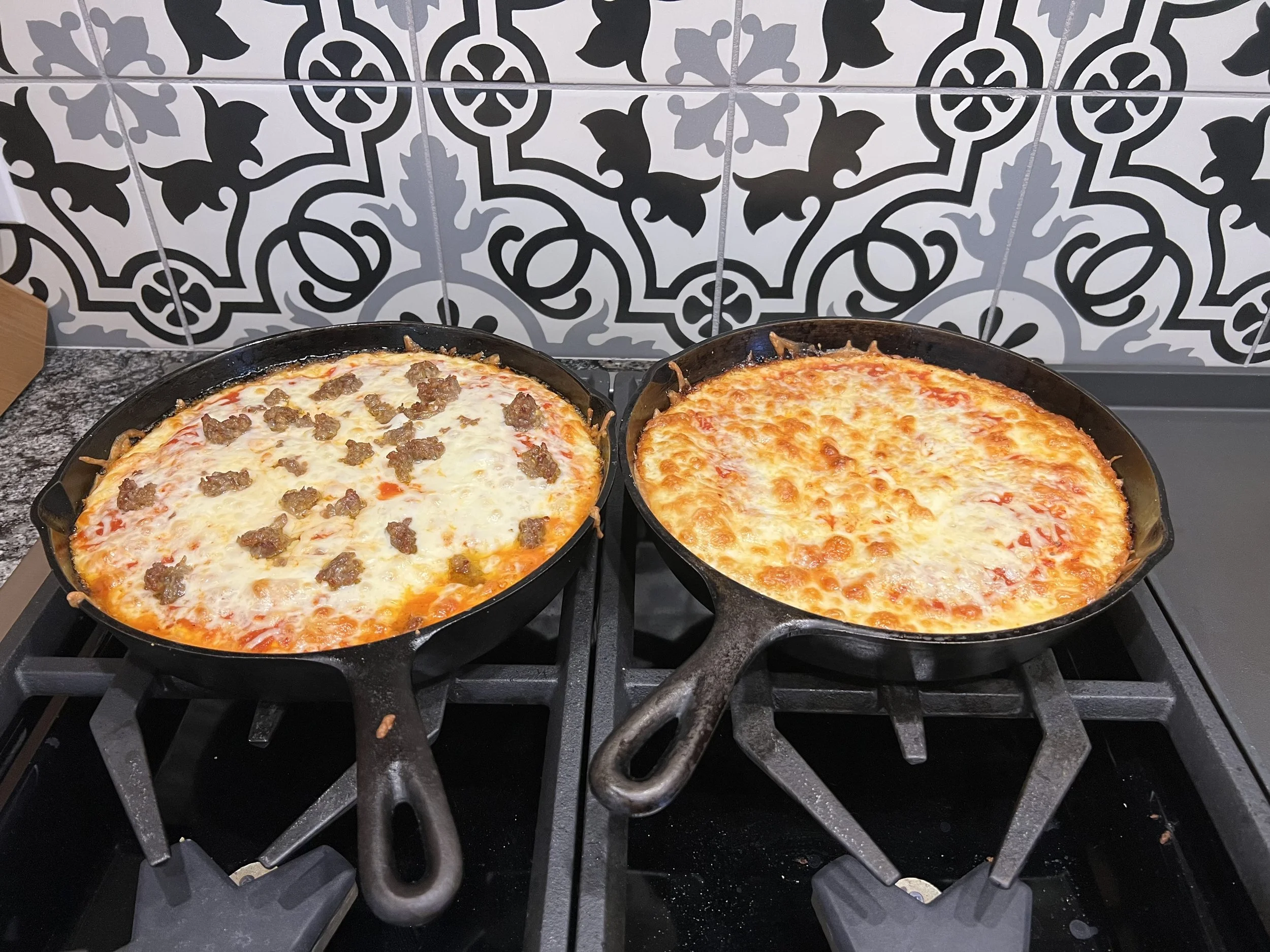
Dave’s Detroit Style Cast Iron Pizza
Afterburner Success Partners
What’s in it for me?
Good eats, that’s what!
Call to Action
Show someone how much you love them by preparing a delicious meal for them. Later, enjoy the time and money you save by relishing your leftovers, either for lunch at work or dinner at home. Take comfort in knowing you are eating healthy food you prepared. All because you made a good decision to follow the recipes and tips in the cookbook I developed just for you.
Besides getting a copy of the cookbook for yourself, it makes an excellent gift for those you love and care for, especially for those with a young family who are looking to save time and money in the kitchen. And learn a few things in the process! What a great idea!
Recommended Resources
Everyday Cooking for Everyday People Like Us by David Giustozzi (Note 1).
Up Next
Back to our regular post schedule.
Notes
Please note that as an Amazon Affiliate, I may earn a small commission on the sale of any of these recommended resources.
Everyday Cooking for Everyday People Like Us by David Giustozzi: https://amzn.to/437OhVQ