
Why You Should Consider Establishing Your Own Family Sovereign Wealth Fund
You might want to consider establishing your own family sovereign wealth fund. Never heard of a sovereign wealth fund? Aren’t those just for rich Middle East oil-producing countries?
An off schedule post
This is an off-schedule post. That means something different or interesting is going on that warrants paying attention to. So, my friends, read on to find out more!
Introduction
Today I’m going to ask you to consider something I’ve never heard anyone advocate before. At least not using the term I just did above. I’m going to make the case that you might, just might, want to establish your own family sovereign wealth fund. If you’re not familiar with this term, think of it as an endowment or perhaps a take on a trust fund. We’ll discuss all of them. This should be fun and educational! Be sure to read to the end…You’ll see why.
What is an endowment?
A financial endowment is a sum of money, often donated, to fund specific activities. A key feature of an endowment is that the principal remains intact, and the investment returns fund the desired activities, often scholarships, research, faculty salaries, building funds, athletic programs, or other special programs. Endowments are often associated with universities, hospitals, or charities. Properly managed, an endowment can fund desired activities in perpetuity (that’s forever).
Donors often legally restrict how funds may be used to ensure their wishes are carried out. At universities, you may have heard of “the Mr. and Mrs. John Smith scholarship fund,” or the “Jerry Johnson endowed Engineering Chair” that could fund a specific facility position and may include funding for research, student assistants, and other necessary needs to support the desired cause.
Many of the largest universities have huge endowments. Examples include Harvard ($56 billion), Yale ($44 billion), and Stanford ($41 billion). As you can tell, with this kind of money, a lot of things are possible.
What is a sovereign wealth fund?
If you’ve never heard of a sovereign wealth fund, it’s understandable. And the reason is that it is typically a government entity that invests surplus wealth into projects that benefit the population. And if you noted that the United States does not have a sovereign wealth fund, you would be correct. Because we don’t have surplus funds.
In fact, we have a deficit to the tune of $2.1 trillion (Note: When I first wrote this post in July, the deficit was $1.9 trillion). A deficit is the difference between our income and our spending. It’s a bad, bad thing. Did I mention that continually running a deficit is a terrible thing to do? If you carry a credit card balance, you know what I’m talking about. Someday, the chickens are going to come home to roost, and all this money will need to be repaid. And guess who will be doing that repaying? Yes, that’s all of us. Remember how we keep talking about protecting yourself for when this day comes? Yes, there are people who think the day may never come, and we can keep on as we are. I don’t believe that; I believe in preparing so we don’t suffer as much as those who aren't prepared.
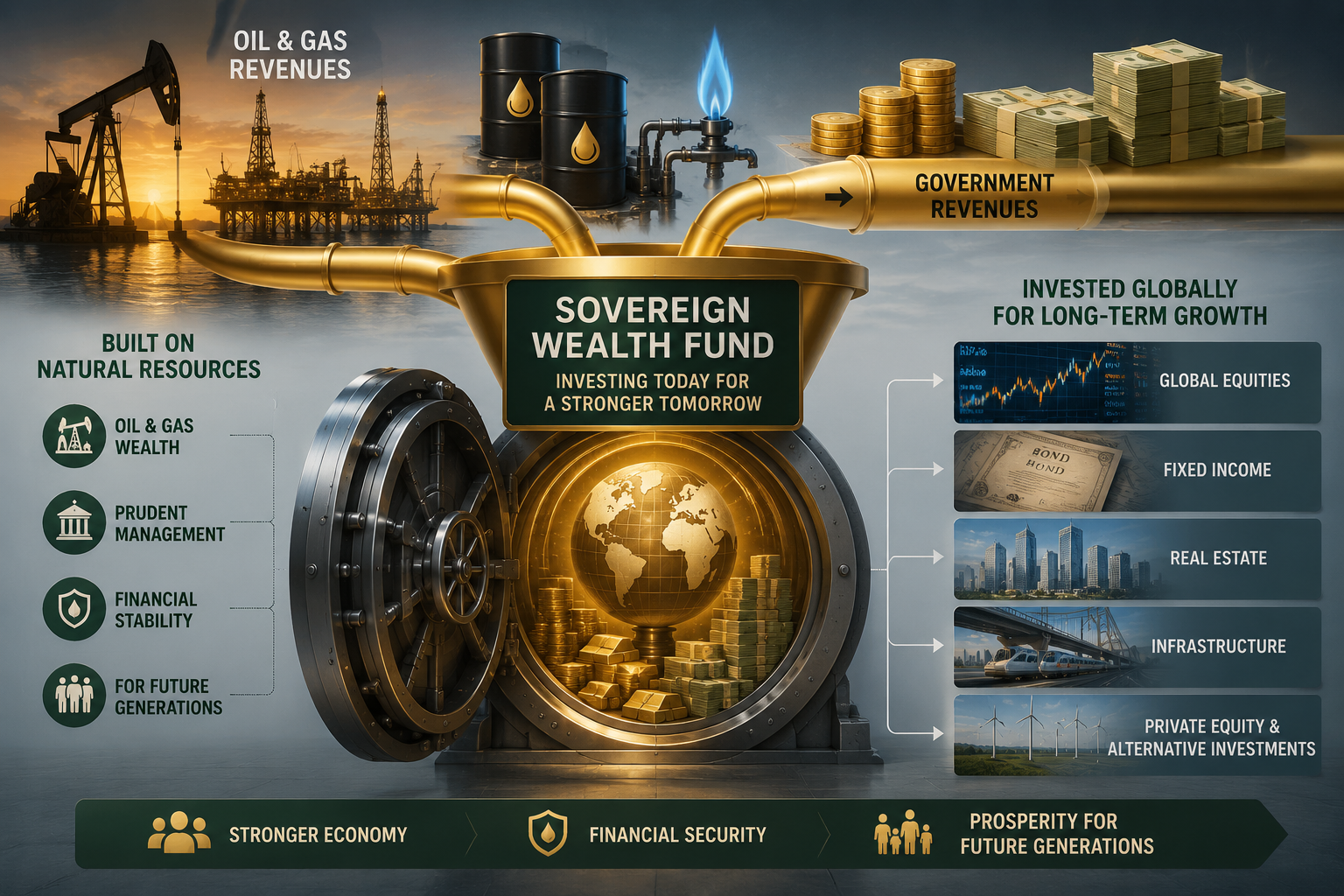
If you have heard of a sovereign wealth fund, you’ve probably typically associated it with Middle Eastern oil and gas-producing countries. Interestingly, Norway has the largest sovereign wealth fund in the world, with an estimated 2026 wealth of $1.8 trillion, funded almost entirely by North Sea oil and affectionately called simply the “oil fund.” Other countries with large sovereign wealth funds include Abu Dhabi (Abu Dhabi Investment Authority), China (China Investment Corporation), and Saudi Arabia (Public Investment Fund).
Because of their size, sovereign wealth funds' investments can influence global markets, real estate prices, corporate ownership, and geopolitics. Hmmm, you say…Quite interesting, huh? Did that get you thinking?
Sovereign wealth funds differ from a country's central bank, which typically manages monetary policy, sets interest rates, and provides stability for that country's currency.
Here is an interesting story. In 2026, Oklahoma, where I live, established a sovereign wealth fund, the Oklahoma Taxpayer Endowment Fund, and seeded it with an initial $200 million investment. The goal is to produce, over time, a reliable state income stream to secure and fund core services and to set Oklahoma on a path toward eliminating its state income tax (Note 1). If you think this is an excellent idea, then you and I are on the same page.
OK, so that thought of eliminating state income taxes for residents of Oklahoma piqued my interest, because, hey, who doesn't want to eliminate state taxes? But how much would need to be in the fund to do that? Remember, what must happen is that the balance is large enough for investment returns to fund all the needed government services. At least all services for a point in time. And assuming the state does not want to fund more and more things. Oh, yeah, that probably won’t happen…(grin).
How would we get such an answer? I’m sure there are smart people who can figure out that answer, but for you and me, the answer is to use AI to give us an estimate. The answer I got was that Oklahoma will need a sovereign wealth fund balance of about $160 billion. Now, I’m not the sharpest knife in the drawer, and while I applaud the effort, I’m not sure I’m going to be around to enjoy that day we get to zero state taxes.
Perhaps a family trust fund?
While you may not be familiar with a sovereign wealth fund or even an endowment, you likely are familiar with a family trust. Many families set up trusts, which are legal arrangements drafted by an attorney, to avoid probate, pass wealth to future generations, protect assets, and more. Typically, one person in the family is designated to manage the trust for the benefit of the entire family.
A family trust typically holds items such as the family home, investments, and perhaps a business. The trust can be very specific about how the organizer wants the assets used. For example, assets could be held until children reach a certain age. Assets could be donated to specific causes, such as charities or to pay for a child’s college.
Family trusts are typically set up as revocable (can be changed) or irrevocable (typically cannot be changed), depending on various factors the family considers important.
Could you really do this?
As you know, I always advocate consulting trusted professionals when we are not well educated on a subject, and that is the case here.
To be frank, the idea of a family setting up a sovereign wealth fund was something I threw out there to pique your interest. And while I’ve never heard of a family sovereign wealth fund, what I am trying to do is to encourage you to think about what your legacy will be and, perhaps, take efforts to ensure that now, while you can. What form that takes is entirely up to you, your attorney, and your investment advisor.
While the name may be a ruse, the principle is sound. Here are a few things to think about. Perhaps you want to donate to your church or favorite charity beyond your normal tithes. Perhaps you want to start an IRA for your children or grandchildren. You could fund a scholarship for children who may lack the means to attend college. I think you get the point. And that point is that, through your financial contributions, which you build by following the process we advocate at Afterburner Success Partners, you give back to others who are unable to return the favor. This is a true legacy, and it lives on long after you are gone.
Perhaps you will choose to give anonymously, as the Bible tells us. “But when you give to the needy, do not let your left hand know what your right hand is doing, so that your giving may be in secret. Then your Father, who sees what is done in secret, will reward you (Matthew 6:3-4).
Summary
I hope I’ve made my point, even though I perhaps used a bit of sleight of hand to draw you in. If you follow the principles outlined in the Afterburner Success Partners course, book, or these blog posts, you should, over your lifetime, end up with a surplus.
My goal here is to encourage you to consider establishing a fund that can support your desired activities through investment returns while keeping the principal intact, so it lasts after you are gone. Your legacy. If this sounds a bit different to you, it is because it is. Typically, when we hear others discuss investing for retirement, we hear folks talk about wanting to draw down their funds over 30 years. Using this philosophy, you would, ideally, die with zero. Perhaps you remember that I recommended a book by this title (Note 2). I enjoyed reading the book, but I’d rather have money left over that would do good than simply pass away with nothing left.
I’d really rather have a surplus. That I can do good with. To give back.
That’s it for this week!
Let’s help our friends and loved ones, shall we?
If you find the information in this post useful or enjoyable, please forward it to those you care about.
Then, simply say, “Search the internet for Afterburner Success Partners
to learn how to achieve your dreams and live your best life!”
Sovereign Wealth Funds
Afterburner Success Partners
What’s in it for Me
If we want to get what we want from life, we need to accumulate as much knowledge and experience as we can. Then we must take that knowledge and experience and act with determination. Doing so will ensure we get what we want, and that’s what’s in it for me.
Call to Action
Honestly consider if you need to make some changes. Or, perhaps you may want to learn a few things. Purchase any of the books noted below. Take the Afterburner Success Partners course. Tell a friend.
Recommended Resources
Buy and read any of the books mentioned in the notes below.
Up Next
Back to regular posting schedule.
Notes
Please note that as an Amazon Affiliate, I may earn a small commission on the sale of any of these recommended resources.
Governor Stitt Comments on Budget Deal, oklahoma.gov: https://oklahoma.gov/governor/newsroom/newsroom/2026/governor-stitt-comments-on-budget-deal.html
Die with Zero by Bill Perkins: https://amzn.to/3RIwijv
Achieve Your Dreams: A Complete Guide to Live Your Best Life by David Giustozzi: https://amzn.to/3IxEFgy
Everyday Cooking for Everyday People Like Us, by David Giustozzi: https://amzn.to/437OhVQ