Lessons from a Benedictine Abbey
Pray and work. Lessons I learned from a Benedictine Abbey.
An off schedule post
This is an off-schedule post. That means something different or interesting is going on that warrants paying attention to. So, my friends, read on to find out more!
Introduction
At Christmastime, our thoughts turn to our Savior Jesus Christ, whose birth we celebrate on December 25. I say celebrate the birth of Jesus on December 25 because, in fact, we really don’t know when He was born. Any documented discussion of Jesus’ birthday did not come until the year 336. If you’ve not heard any of this before, click on the link in Note 1 to learn more.
Regardless, Christmas is a time we traditionally set aside as a religious holiday. Sadly, it has also become a massive season of consumption, such that, to me at least, it can, if we let it, overwhelm the true meaning of Christmas. Coming shortly after Thanksgiving, the “holiday season” for me is one of thankfulness and awe of the blessings we have been given. I think we all understand that not everyone in the world is as blessed as we are in Western countries, and the holiday season is often also a time for giving to those in need, which many people generously do. How did the tradition of giving gifts start? Giving gifts at Christmas began with the three wise men (Note 2) and, over the years, probably just got carried away into what we have today. Do you feel we’ve lost “the reason for the season?”
It is this discussion of faith that prompted me to recall our visit to an impressive abbey this past summer and an important lesson I learned, which I would like to share with you during this holiday season.
The Gottweig Abbey
I’ve mentioned previously that Diane and I shared a wonderful Danube river cruise with some very good friends this past summer. We began our trip with a flight into Budapest, Hungary. Besides seeing beautiful Budapest, we also visited Bratislava, Slovakia; Vienna, Dürnstein, the Wachau Valley, and the Benedictine Gottweig Abbey in Austria. We visited Passau and Regensburg, Germany, where our cruise ended. We then traveled to Munich for a day, where we split with our travel companions. Diane and I took a very nice, but rather long train on the Mannheim-Saarbrucken railway to visit my daughter in Western Germany for a few more days. What a trip!
Oh, and did you know there is a town in Germany called Frankenstein? We made a brief stop there. It’s in the Kaiserslautern district, which was not that far from the town of Miesau, where we exited the train. Technically, Miesau is called Bruchmuhlback-Miesau, but it’s pretty much just called Miesau. There is a little grocery store we’ve shopped at there called Edeka, where we would buy fresh pastries, excellent fruits and vegetables, and delicious seasoned meats. I just learned, while researching this article, that Edeka is the largest German supermarket corporation. Who knew!
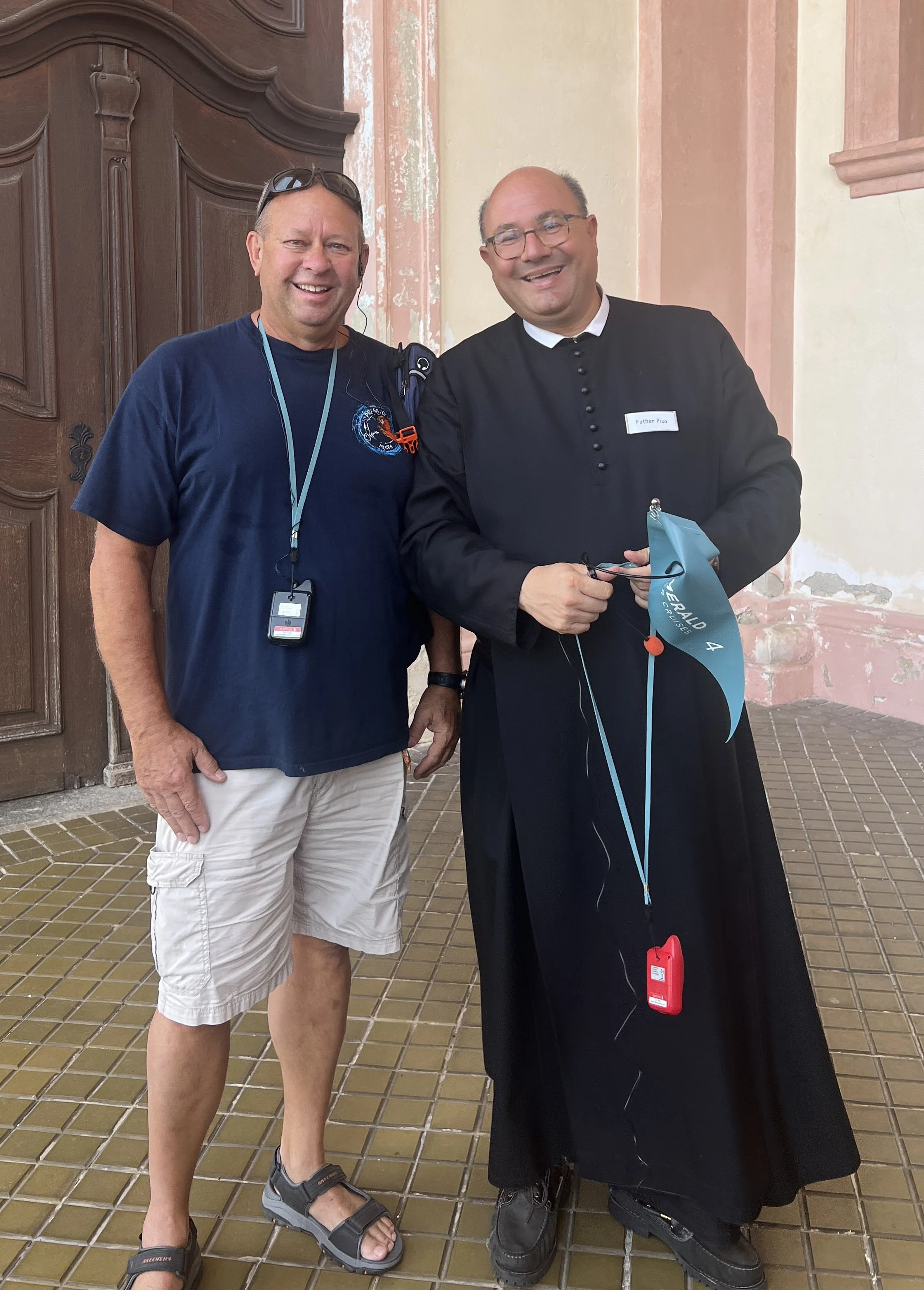
When you tour Gottweig Abbey (Note 3), you are divided into small groups paired with a tour guide, who is typically a staff member or a lay person. Well, we were fortunate to be hosted by Father Pius, an Abbey priest. One of his jobs is to be in charge of social media and communication for the abbey. He was a very happy guy, and we learned about the history of this abbey that was established in 1083. I can’t help but think we got a bit more history than the average tourist.
The abbey is home to 34 monks, who support themselves and the abbey with an on-site restaurant, guest house, and museum, among other activities. Between the history, architecture, and the stunning views, it’s a place you want to visit if you are able. As you enter the abbey, you are greeted with a sign above the entry-Pax, which means Peace. At the beginning of the tour, Father Pius introduced us to the term Pray and Work, ora et labora, in Latin. It was this term, pray and work, and Father Pius’ discussion of it, that I have been pondering since visiting the abbey several months ago. As such, I had to research it a little bit more, and that’s what I want to talk about today.
Part of my research revealed that we have two abbeys in Oklahoma: Our Lady of Clear Creek (Note 5), and St. Gregory’s (Note 6). I seem to have heard of one of them, but looking at their websites caused me to want to visit them soon!
Ora et labora
“Pray and work” (ora et labora), along with “to work is to pray” (laborare est orare), are practices associated with the Benedictine practice of leading balanced lives. Now, if taking a break from praying to work is perhaps not your idea of a balanced life, I’m guessing you are not alone.
Saint Benedict believed that prayer should be balanced by work because idleness is the enemy of the soul (Note 4). I’m sure what is meant by this is that, even for the most devoted, it is not physically or mentally possible to pray every waking moment, so the issue is what to do in that period of time when one is not praying, eating, or sleeping? For the Benedictines, work often means some form of farm or agricultural work, usually used to support the ministry. The underlying gist of this concept of working and praying, and that idleness is the enemy of the soul, is really a pretty good formula for a well-lived life. Let me explain what I mean by that.
What else is there?
If we think about this for a few minutes, we will realize that, in the modern world, our concept of a balanced life includes leisure activities and then, someday, if we are fortunate, retirement. These concepts were not part of life in past generations, and I want to ask you to ponder if the modern conveniences we have are really “the enemy of our soul” as the Benedictines knew so many years ago. Let me give a few examples of what I am thinking, and you can see if you agree with me or not:
Prayer is part of our faith and, besides guiding us in living our lives, provides us with comfort and a focus on eternity. Indeed, prayer is healthy for us.
Work provides not only a method of income and a way to support ourselves, but also a way to take care of our bodies. I often chuckle when I think of people going to a gym to work out or jogging to stay in shape. If a person works on a farm, there is no need for a gym! Hard work is good for us for several reasons.
Idleness is the enemy of the soul. I want to update this saying just a bit: “An idle mind is the devil’s workshop.” I remember traveling for work and being in hotel rooms alone at night with nothing to do. It’s the same when we don’t have productive activities to engage in; our minds and thoughts can wander to things that aren't healthy. An idle body gets out of shape. Thus, idleness is destructive not only for our minds but also for our bodies. Sadly, we’ve even seen people who act out on destructive thoughts. I think we all wonder if our thought lives are manipulated or at least influenced negatively by what we can view on our phones or computers.
As we age, it becomes more essential to keep our minds active and our bodies moving, as this slows the aging process. Recent research is uncovering the link between dementia and a busy mind, and we’ve known for years about the link between physical activity and a healthy body.
In summary
As I get older and more experienced, I continue to find reinforcement in practices of long ago, the wisdom of Biblical teachings, and the problems with excess in our modern lives. Don’t get me wrong, I enjoy many of today’s modern conveniences. It’s the excess or improper use of these conveniences that concerns me. If cell phones and social media, along with American restaurant-sized meals, come to mind, you and I are on the same page.
During this Christmas season, think about these concepts and ask yourself what a balanced life looks like to you. Yes, today we probably need more than just prayer and work. But probably not more to the point that it is in excess and hurts us.
That’s all for this week!
Let’s help our friends and loved ones, shall we?
If you find the information in this post useful or enjoyable, please forward it to those you care about.
Then, simply say, “Search the internet for Afterburner Success Partners
to learn how to achieve your dreams and live your best life!”
Lessons from a Benedictine Abbey
Afterburner Success Partners
What’s in it for Me
Staying on track and on schedule is essential to really get and do the things we want to do. Understanding when we may get off track and what to do about it is necessary to accomplish life goals. Finding balance in everything we do is one way to ensure healthy bodies and minds, so we can be most productive.
Call to Action
Take the Afterburner Success Partners course or purchase the book Achieve Your Dreams: A Complete Guide to Live Your Best Life by David Giustozzi (Note 7).
Recommended Resources
Check out my recently published book, Achieve Your Dreams: A Complete Guide to Live Your Best Life by David Giustozzi. Available on Amazon or on my website. See Note .
Up Next
Back to regular posting schedule.
Notes
Please note that as an Amazon Affiliate, I may earn a small commission on the sale of any of these recommended resources.
Was Jesus born on December 25? Was December 25 Jesus’ birthday?, Gotquestions.org: https://www.gotquestions.org/December-25.html
Billy Graham “My answer,” billygraham.org: https://billygraham.org/answers/why-do-we-exchange-christmas-gifts-billy-graham-answers
Gottweig Abbey: https://www.stiftgoettweig.at/portal/en/visitexperience
ora et labora, Wikipedia: https://en.wikipedia.org/wiki/Ora_et_labora
Our Lady of Clear Creek Abbey: https://clearcreekmonks.org/?srsltid=AfmBOorDavd4K7Nai5SWlJSj_mqMVmgFf9zh5sWd8bO_V1K7H_feBEBx
St. Gregory’s Abbey: https://monksok.org
Achieve Your Dreams: A Complete Guide to Live Your Best Life by David Giustozzi: https://amzn.to/3IxEFgy