To AI Or Not To AI, That Is The Question
To AI or not to AI, that is the question…
An off schedule post
This is an off-schedule post. That means something different or interesting is going on that warrants paying attention to. So, my friends, read on to find out more!
Introduction
Did you like my little play on words at the top of this post? You may remember studying the playwright William Shakespeare (1564-1616) in school, and the line above is a twist on the famous line from the play Hamlet. “To be or not to be” was from a moment when Hamlet was contemplating life and death (even suicide, see Note 1 for important information on this subject), weighing the suffering of life against the uncertainty (to him at least) of what lies beyond.
To understand the context, the line was spoken by Hamlet after his father’s death and his mother’s hasty remarriage to his uncle, who is now the king. Hamlet is filled with grief and desires revenge, and his comments are simply a question of whether to live or to die. I never studied Shakespeare in school, other than a passing discussion of him. The arts were well taught in the schools I attended, so I’m not sure why. I’ve often told myself that someday I will become more familiar with Shakespeare’s work. Unfortunately, someday has not arrived yet. Did you study Shakespeare? What were your thoughts on his work?
But today, we’re going to discuss artificial intelligence (AI) not Shakespeare.
I’m going to break this post into four basic sections: everyday uses of AI for consumers, AI in business, AI as an investment, and, finally, the impact of AI data centers. I’ll then summarize the discussion at the end.
Everyday uses for Artificial Intelligence
I’m sure you’ve heard of artificial intelligence, AI for short, by now. Right? It’s part of your daily life, whether you know it or not. At its most basic level, AI enables machines to perform tasks that would otherwise require a human. Here are a few examples:
1. Everyday Consumer Technology
Virtual assistants like Siri, Alexa, and Google Assistant
Recommendations on Netflix, YouTube, Amazon, Spotify
Smartphone features such as facial recognition and predictive text
2. Business and Industry
Automation of repetitive tasks (data entry, scheduling, customer support chatbots)
Data analysis and forecasting for finance, marketing, and operations
Quality control in manufacturing
3. Healthcare
Medical imaging analysis (detecting tumors, identifying diseases)
Drug discovery and research
Personalized treatment plans
Virtual health assistants
4. Transportation
Self-driving cars and driver-assistance systems
Traffic prediction and route optimization
Logistics automation (delivery, fleet management)
5. Security and Safety
Fraud detection (credit cards, banking)
Cybersecurity threat detection
Video surveillance analytics
6. Education
Personalized learning software
Automated grading tools
Tutoring systems that adjust to a student’s needs
7. Entertainment and Creativity
Image and video generation
Music composition and art creation
Game design and smarter NPC behavior
8. Science and Research
Climate modeling and prediction
Genetic research
Automation of experiments and simulations
9. Communication
Language translation
Speech-to-text and text-to-speech tools
Email and document drafting assistance
Are some of these uses familiar to you? For me, the most common are when I use Google Home, watch a movie on Amazon Prime or Apple, and they recommend a similar film to watch next, or when I see a chatbot when accessing a website. Fraud has been detected in my (fraudulent) credit card usage. It’s incredible to me how they do that. Additionally, I use Grammarly and Microsoft Copilot in my writing, and of course, Google uses it as part of its search function. I often find myself frustrated with Grammarly and Copilot as they attempt to normalize my writing style into something vanilla, and I don’t like that. I want my style to be uniquely me, and I often do not accept their recommendations on how I should write. What examples can you think of that you use AI for? Whether you can name any or not, likely, you are more impacted by AI in your daily life than you realize.
AI in business
Besides our daily use of AI as consumers, you have likely been affected by AI in the business world, either positively or negatively. What are some examples? Let’s see:
1. Automation of Routine Tasks that save time and reduce labor costs.
Data entry and processing
Scheduling and workflow automation
Document classification
Customer support chatbots and automated responses
2. Customer Experience & Sales that lead to higher customer satisfaction and increased sales.
Chatbots and virtual assistants for 24/7 customer service
Personalized product recommendations
Lead scoring to identify high-value prospects
Sales forecasting
3. Marketing Optimization that helps companies create more effective campaigns with lower cost.
Targeted advertising based on customer behavior
Automated content creation
Sentiment analysis of customer feedback and social media
Customer segmentation
4. Data Analysis & Decision Support that uses AI insights to make faster, more accurate decisions.
Predictive analytics (forecasting demand, revenue, churn)
Real-time dashboards powered by AI
Scenario modeling and risk analysis
5. Fraud Detection & Security that protects assets and reduces losses.
Transaction monitoring in finance and online retail
User behavior analysis to catch anomalies
Cybersecurity systems that identify and block threats automatically
6. Human Resources & Talent Management teams use AI to reduce bias, hire faster, and retain employees.
Resume screening and ranking candidates
Employee attrition prediction
AI-driven training and skill development tools
7. Operations & Supply Chain Management uses AI applications to reduce cost and improve reliability.
Inventory forecasting
Route optimization for deliveries
Predictive maintenance on equipment
Demand planning
8. Financial Management uses AI to speed up financial processes and improve accuracy.
Automated bookkeeping and reconciliations
Cash-flow forecasting
Expense categorization
Credit scoring
9. Product Development to shorten development cycles and add new capabilities
Rapid prototyping
AI-assisted design
Testing simulations
Voice-activated or smart features in products
The November 8-9 issue of The Wall Street Journal had an interesting article titled Use AI, or You’re Fired and described how at least one firm, Accenture is “exiting” employees who are not learning AI in the manner expected. This, after the firm with 779,000 employees has trained 70% of its employees to date in AI fundamentals.
If you are an entry-level employee, you may be discovering that some entry-level jobs no longer exist as AI can perform them. I’ll discuss this a bit more in the Summary section.
AI for investors
Do you own any stock in AI firms? Well, you may own some directly, or you may find you are an owner as part of a mutual fund or other investment vehicle. Heck, you may not even know if you are an owner!
There is a lot of chatter going on right now regarding if investing in AI companies is a good strategy or not. I often listen to an investment advice program on the radio, and the host’s answer to this question was simply, “It depends.” What he was saying is that one cannot broadly define investments in AI technology as good or bad, just that some companies will be profitable and others will not. Like all investing, it pays to do your research. Or have a good financial advisor who does.
The November 15-16 issue of The Wall Street Journal has at least two interesting articles on this topic. The November 18, 2025, post by The Motley Fool (Note 2) offers another perspective. Edward Jones offers advice as well (Note 3)
What do you think? I like the radio host's advice the best. It depends upon where you are in life, your risk tolerance, and the companies you choose to invest in. You know me by now; I always advocate educating yourself on these matters and working with your financial advisor to determine what’s best for you and your family.
AI data centers
Do you have an AI data center near where you live? Is one planned? There are at least two planned for the Tulsa area, where I live, and they are a paradox to me. Two more were recently announced in the Muskogee area. AI data centers in Muskogee, OK? What? On the one hand, as consumers, we love the information that is available to us with a few keyboard strokes. If AI takes your job, then you may not like it as much.
From a physical plant perspective, I have to say I don’t think I like them. The ones in my area haven't been built yet, but from what I’ve read, they are noisy. They also consume massive amounts of electricity and water to keep things cool. While data centers will generate substantial tax revenue, they provide few jobs. Frankly, from what I can tell, the draw of the taxes to politicians is overcoming the objections of neighbors who do not want them in their backyard. You’ve heard of NIMBY, haven’t you? Not In My Back Yard. It’s OK if it’s in someone else’s backyard, just not mine.
And then there is the question of who will pay for all the electricity and water that data centers use? Guess what the answer is? I’ll bet you already know…
I read an interesting twist on this in the November 15-16, 2025, issue of The Wall Street Journal. The gist of the article is that the costs to build these data centers (roughly $3 trillion) are so great that only about half of the needed funding can be generated by expected cash flow. The remaining half (about $1.5 trillion) will have to come from the bigger funding markets, such as high-grade bonds. And insurance companies, which often fund retirement accounts, are natural buyers of data center debt, meaning, according to the article, that retirees will likely be the ones to fund data centers. If you can, read this article to understand this issue better.
Because if you use electricity, water, or want to retire, data centers likely directly impact you.
Summary
Whew! This has been exhausting! I think we can all see that, like it or not, AI is not only coming, it’s here and impacts us directly. I benefit from AI daily, as do you, and all these things I discussed are important and affect each of us in different ways. What I’m particularly interested in is its effects on the workforce and as an investment opportunity. Let me explain these to you…
I’m reading a lot of hype (that’s my take on it) lately about how AI is taking entry-level jobs and causing people to lose their jobs. Who could not be sympathetic to that? But the fact is that, as long as we have all been in the workforce, there have been threats to our jobs. Whether it was the industrial revolution, the introduction of computers, or whatever. The fact is that the only constant is change. Period. The end. And, for us as individuals, we must recognize that and adapt. Or sit in the corner and wring our hands, but that really won’t solve anything. By not changing and adapting, we will be the losers.
Are you invested in AI? It will be interesting to see where it goes. If you own or have owned stock in Nvidia, then you are already a beneficiary of AI. How about the other companies that are strictly AI or use or will use AI? Meta, Amazon, Google, Microsoft, Anthropic, what have you. In my family, we are somewhat invested in AI through some of the funds we are in.
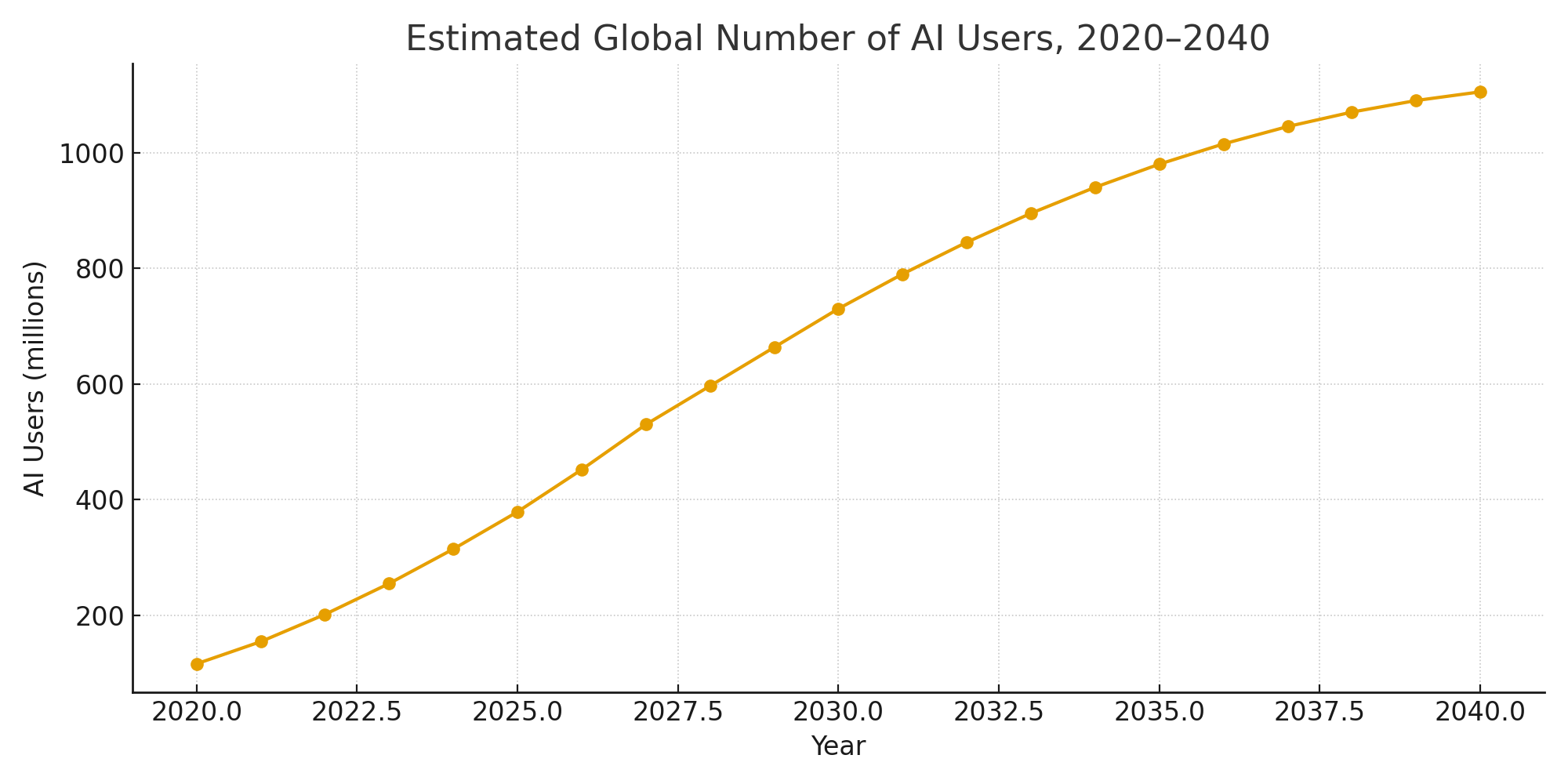
And finally, just so you know, because I know you are curious…Yes, I did use AI in writing this post. I used ChatGPT to generate the two lists you see above and the chart in the illustration. I used Google AI for some internet searches and then Grammarly and Copilot to check my writing. Although I don’t let it change my style. Which AI often tries to do.
All while listening to smooth jazz, simply by saying “OK Google, play smooth jazz on Pandora…”
That’s all for this week!
Let’s help our friends and loved ones, shall we?
If you find the information in this post useful or enjoyable, please forward it to those you care about.
Then, simply say, “Search the internet for Afterburner Success Partners
to learn how to achieve your dreams and live your best life!”
To AI Or Not To AI, That Is The Question
Afterburner Success Partners
What’s in it for Me
I’m afraid you will use AI whether you like it or not. My suggestion is to accept that it’s here and you should make the best of it just like you did your cell phone, your tablet, Alexa ,and your Google Home. If you are working, then you have more than just a passing incentive to learn AI and use it to advance your career. You don’t want to be one of those who were “exited” for not adapting. Because the next potential employer is using it too.
Call to Action
Think about how you need to be changing as AI becomes more integrated into our daily lives. What specifically will you need to do? Remember, our goal at Afterburner Success Partners is not only to survive but thrive!
Recommended Resources
Check out my recently published book, Achieve Your Dreams: A Complete Guide to Live Your Best Life by David Giustozzi. Available on Amazon or on my website. See Note 4.
Up Next
Back to regular posting schedule.
Notes
Please note that as an Amazon Affiliate, I may earn a small commission on the sale of any of these recommended resources.
Please note there is a national suicide prevention hotline, and it is 1-800-273-TALK (8255). 988 is a simple number that can be texted or called. The website is 988lifeline.org
Investing in AI: What You Should Know, Edward Jones: https://www.edwardjones.com/us-en/market-news-insights/guidance-perspective/investing-ai
Achieve Your Dreams: A Complete Guide to Live Your Best Life by David Giustozzi: https://amzn.to/3IxEFgy