
Why Is Everyone So Angry? The Anger Iceberg
Does it seem to you like everyone is always angry? Yeah, me too.
An off schedule post
This is an off-schedule post. That means something different or interesting is going on that warrants paying attention to. So, my friends, read on to find out more!
Introduction
Does it seem like everyone you see, everywhere you go is angry? It seems that way to me as well so I thought I would do a little research into it. As I like to say, timing is everything and of course my observations of anger in the world around me corresponded with me reading about the topic in a wonderful book by Dan Goleman titled Emotional Intelligence (Note 1).
Here is what I found. Be sure to check out the sources I reference in the notes for a better understanding of this important issue.
The purpose of anger
Anger is one of the six basic emotions as defined by Paul Ekman in his interactive tool Atlas of Emotions (Note 2 this is really cool). The others are disgust, fear, happiness, sadness, and surprise. When we are angry, anger causes blood to flow to our hands, making it easier to hold a weapon or strike an enemy. Our heart rate speeds up and we experience a rush of hormones, including adrenaline, which creates a surge of energy strong enough to take “vigorous action.” Basically, anger protects us (Note 3).
The anger iceberg
But anger is more than just a defense mechanism. When we are angry, it is often a result of other emotions hidden beneath the surface. Our expression of anger can be the visible result of unexpressed feelings (Note 4).
If you are not familiar with icebergs, the portion of an iceberg that is visible is only a small part, and the bulk of the iceberg remains below the surface of the water, unseen. The anger iceberg (see accompanying illustration and Note 4) is made up of three distinct parts:
Tip of the iceberg: What we show those around us.
Middle of the iceberg: The hidden emotions driving our anger
Bottom of the iceberg: The deep, complex part where our thoughts and values reside.
What are these emotions that are not visible, hiding out of view, and fueling our anger? They may include:
Fear-Anger is sometimes a manifestation of fear, and anger kicks in as a self-defense mechanism.
Frustration-Frustration can be expressed as anger and is an unhealthy way to express it.
Hurt-A result of being hurt often is expressed as anger, again a way to protect ourselves.
Disappointment-disappointment can easily be turned to anger if we are not careful.
Stress-Stress is harmful in many ways, often resulting in anger (Dave speaking here: I believe stress is a huge cause of anger. I don’t have a way to prove that. It’s just my observation).
Insecurity-a feeling of powerlessness can result in anger (Dave here again: I think this is another reason for anger in the modern world. Especially given how insecure our jobs and marriages are. “Back in the day,” it seems we had more stability in both of these areas. I believe that the elimination of pensions as a result of the 401 (k) was probably the beginning of a lack of loyalty by both employers and employees that contributes to this issue. Regarding marriages, they just seem to be disposable and laws that make divorce easy and with no-fault have not helped. Again, no hard data for these thoughts, it’s just how I feel.)
Guilt or shame-If we feel guilt or shame about something we have done, it can be expressed by anger (Note 4)
OK, I’m back, and I’m going to add a few of my own, not clinical, not scientific reasons, of why I believe people are so angry. After you read mine, which are strictly from my own observations of people and things around me, consider the ones above, think about the reasons everyone is so angry, and see if you have any to add. At least we can make this discussion a little fun. Here are mine:
Jealousy (Note 5)
Selfishness (Note 5)
Envy
A sense of entitlement
Laziness
Unreasonable or unmet expectations
Talk radio
Politics
Crime
Lack of or underemployment
Poor nutrition
Poor health
Poor marriage
Social media
Too much time on our hands
Ignorance
Too many choices
Technology
Unappreciativeness of all that we really do have
Mental illness
Abuse
Poor childhood experiences
Over or inappropriate medication
We choose to be angry
Well. That certainly was fun, wasn’t it? Maybe even enough to make you angry? Just kidding…
You would not believe how quickly I compiled that list. It was too easy, really.
When did all of this anger start?
I’d like you to click on the link in Note 6, the source of the following information and just read this for yourself. It’s not very encouraging to me. Here are some statistics from this report:
Negative emotions remain high:
In 2024, 39% of adults worldwide reported experiencing a lot of worry the previous day.
Similarly, 37% of adults reported experiencing a lot of stress the previous day.
Fewer said they experienced daily physical pain (32%), sadness (26%) and anger (22%).
All measures are higher than they were a decade ago.
Positive emotions are steady:
Feeling treated with respect (88%) reached one of the highest levels Gallup has measured.
Daily experiences of laughter (73%), enjoyment (73%) and feeling well-rested (72%) held at long-term averages.
The 52% of adults saying they learned something interesting the previous day dipped slightly but remains higher than it was a decade ago.
Our emotions are shaped by peace:
Sadness, worry and anger were more common in less peaceful countries as measured by the Institute for Economics & Peace’sGlobal Peace Index.
Anger, sadness and physical pain were higher in countries where scores on the Institute for Economics & Peace’s Positive Peace Index are weaker.
Positive emotions such as enjoyment and feeling respected were less common in countries with weaker scores on either index.
So, based upon this report by Gallup, we all started becoming angry in about 2016.
I don’t believe that for one minute. If I could sum it up in one phrase, I would say that, in my opinion, it’s when advancements made our lives too simple. We had too much and too many choices, which gave us too much time to complain, and if you buy my explanation, that would probably be in the late 1950s or early 1960s. Click on the link in Note 8 and look at that graph and see if you agree with me or not.
Managing our anger
I know some people very well who have both attended anger management and also taught it. I’m amazed at the effectiveness of it, and I would recommend it if someone thinks they struggle with anger issues.
From a personal standpoint, without any formal training or education, I’ve worked on managing anger myself by making a conscious decision to not let events make me angry. I think of what my wife Diane says, “In five years will it matter?” It has really helped me. Because, and I will tell you the truth, I have anger issues as much as anyone. Yes, we all seem to, don’t we?
There are other self-help ways to help manage anger, including:
Identify the underlying emotions that cause anger (see above).
Take a moment to breathe and calm yourself.
Practice empathy (Dave speaking: I think this is huge, and if more of us considered others’ feelings, we might find we have less to be angry about).
Identify anger triggers
Focus on effective communication by being calm and clear.
Think before you speak
Walk away or wait until you are calm to express concerns
Get some exercise
Take regular breaks during the day
Try to identify possible solutions to why you are angry
Use “I” statements instead of “you” statements
Don’t hold grudges
Use humor to release tension
Practice relaxation skills
Seek help when needed (Note 7)
Yeah, those are helpful hints, don’t you think?
More on anger management classes
As I mentioned above, I’ve seen excellent results from people I know who have attended anger management classes. Why is that? Well, let’s look for a bit.
Anger management classes typically teach how to recognize anger triggers, understand its causes, and develop healthy coping skills such as deep breathing, changing negative thoughts, and appropriate communication to manage reactions, as well as healthy expressions of power, gratitude, and appreciation, and how to say no. It teaches that anger should be managed rather than suppressed, which in turn leads to better emotional regulation and improved relationships (Notes 9, 10)
Summary
I hope you enjoyed that little journey with me, and I also hope you learned a few things. I sure did. It saddens me that I see so many angry people who can’t just be happy. For me, what has been helpful is recognizing that when I am angry (about a topic or in general), I make a conscious decision that I don’t want to be that way, and then employ the techniques listed above. Like many things in life, if we want to change them, we have to recognize them and decide to change.
That’s all for today!
Let’s help our friends and loved ones, shall we?
If you find the information in this post useful or enjoyable, please forward it to those you care about.
Then, simply say, “Search the internet for Afterburner Success Partners
to learn how to achieve your dreams and live your best life!”
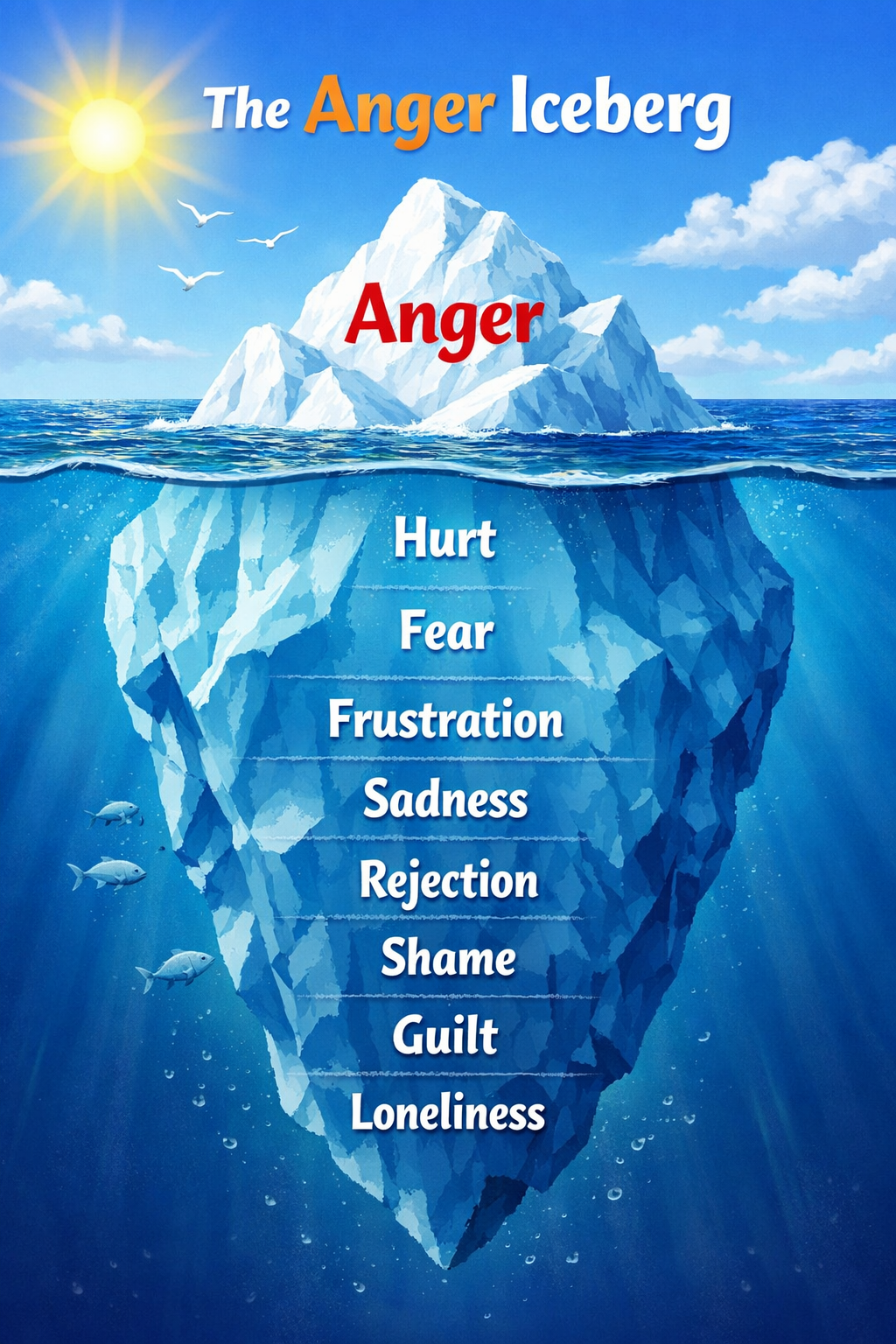
The Anger Iceberg
Afterburner Success Partners
What’s in it for Me
We must always be aware of our knowledge related to what we want to do and ensure what we think we know is true. Then, we must act in a determined manner. Doing so will ensure we get what we want, and that’s what’s in it for me.
Call to Action
Review the material in the notes below. Purchase either of my books. Take the Afterburner Success Partners course. Tell a friend.
Recommended Resources
Buy and read any of the books mentioned in the notes below.
Up Next
Back to regular posting schedule.
Notes
Please note that as an Amazon Affiliate, I may earn a small commission on the sale of any of these recommended resources.
Emotional Intelligence by Dan Goleman: https://amzn.to/44TJERv
The Atlas of Emotion: https://atlasofemotions.org/#triggers/
The Anger Iceberg, John Gottman: https://www.gottman.com/blog/the-anger-iceberg/
Understand Your Anger: The Power of the Anger Iceberg, Cerebral: https://cerebral.com/blog/understand-your-anger-the-power-of-the-anger-iceberg
James 3:16, The Bible. This verse states “For where jealousy and selfish ambition exist, there is disorder and every evil thing.” Some people, and I happen to be one of them, think these two things are the root of all sin.
State of the World’s Health 2025, Gallup: https://www.gallup.com/analytics/349280/gallup-global-emotions-report.aspx
Anger management: 10 tips to tame your temper, The Mayo Clinic: https://www.mayoclinic.org/healthy-lifestyle/adult-health/in-depth/anger-management/art-20045434#:~:text=Practice%20deep%2Dbreathing%20exercises%2C%20imagine,below%20and%20resubmit%20the%20form.
Humanity’s technological growth is exponential, not linear; reddit: https://www.reddit.com/r/humansarespaceorcs/comments/1fb6tpd/humanitys_technological_growth_is_exponential_not/
What happens in anger management classes?; verywellmind.com: https://www.verywellmind.com/what-happens-in-anger-management-classes-4579759
What you will learn in anger management classes; assurasource: https://www.assurasource.com/behavioral-health-blog/5-things-you-will-learn-in-anger-management-classes/
Achieve Your Dreams: A Complete Guide to Live Your Best Life by David Giustozzi: https://amzn.to/3IxEFgy
Everyday Cooking for Everyday People Like Us, by David Giustozzi: https://amzn.to/437OhVQ