
Why You Should Change Your Washing Machine Hoses
When was the last time you changed the hoses on your washing machine? What other maintenance in your life do you need to attend to?
An off schedule post
This is an off-schedule post. That means something different or interesting is going on that warrants paying attention to. So, my friends, read on to find out more!
Introduction
Because I’ve lived a long time now, because I’ve been in the maintenance business for my career, and because I’ve “been around the block a few times,” I know a few things about a few things. Of course, I don’t know a few things about a few things as well. For example, as much as I would like to, I cannot sing a note. Not even in the shower. It’s just horrible. Can’t play a musical instrument, as much as I would love to play the saxophone. I played the accordion as a kid. It’s what Italian kids did. I liked it for about the first year and then I didn’t. Like many people, especially men, I struggle with communication and relationships (Yes! You know what I mean! It’s not sexist if it’s true!!!)
But I do know about mechanical things and taking care of them. And I do know a bit more about relationships than I just let on as well, especially in the world of business. And it’s maintaining your “things” and your other maintenance responsibilities that I want to talk about today. Walk with me, will you?
I didn’t start out to change the washing machine hoses
For a few weeks, maybe a couple of months, I’ve noticed the dryer has started vibrating, like it’s out of balance. Our dryer is pretty old, but more than that, it is high mileage. It’s probably about 20 years old, but when we bought it, we had four kids living at home or in college so we were doing a lot of laundry. A LOT. At some point a long time ago, I noticed the same vibrating so I dug into it. Turns out the drum rollars were worn so I changed them. Less than $40 and problem solved. Fast forward to today, and we have to ask ourselves if we are in a repair or replace situation. Well, the dryer is a higher-end Maytag with a stainless steel drum, and we like it. It dries the clothes quickly and, most importantly, the exhaust duct lines up with the hole in the wall. Yeah, do you know what a pain it is when they don’t? And they never do right? Except this time and I’m so tired of messing with flexible ducts that don’t line up and all the problems that come with that that I never want to do it again. So now things line up. And I’m happy. I’m content. I don’t want to change.
I decide I’m going to fix the dryer. It’s what I do, after all. I bought a belt, rollers, and an idler pulley before I get into the job so I have everything I need before I start. At least I hope I do. $117 bucks. No big deal. Then I tear it apart. Dryers are really simple machines, and I notice that the felt drum seals are worn and more importantly, the felt pads that support and guide the front of the drum are missing, causing it to rub on the blower fan case. Uh-Oh, bigger problems. And mice have built a nest in the exhaust fan cage (causing it to be out of balance). And the lint filter housing (not the removable screen) is about 75% clogged from wet lint. And it’s stuck like glue, so I have to tear it apart now, too. OK, so now this is another $150 in parts and we really are at the “I might should have replaced it” stage. It’s fine, I tell myself, anything that moves is now new, so it probably will last a long time. I hope so…
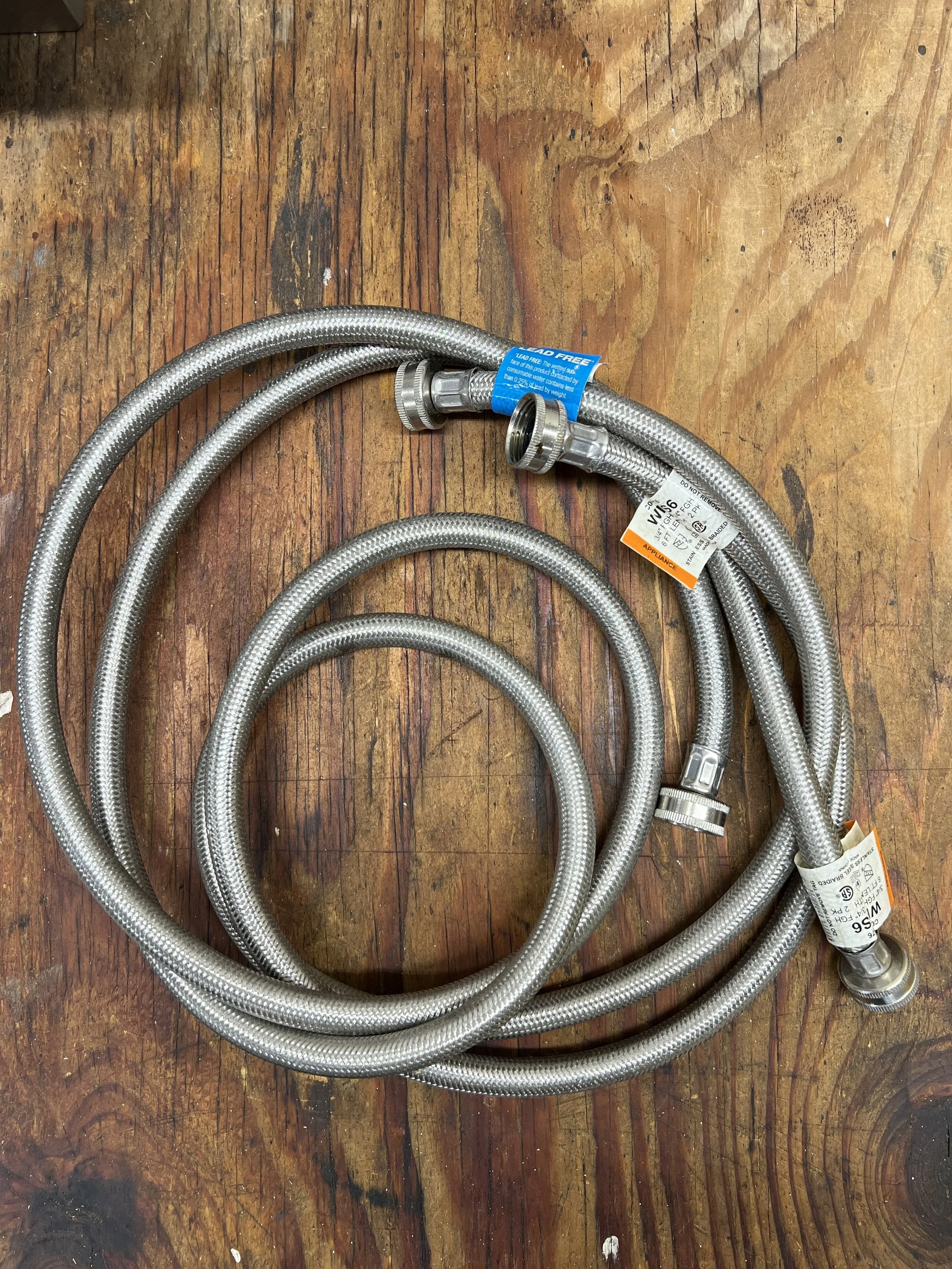
Anyway, I had to pull the washing machine out from the wall to align the dryer duct when I was done and as I did, I asked myself, when was the last time I changed those hoses? I have no idea. Probably should just do it while I’m in there. Only $40 bucks for the braided ones. And then I thought, hmm, I wonder how often I should be changing them?
The answer is that cheaper rubber hoses should be replaced every 5-8 years. The more expensive stainless steel braided ones (which are still rubber, just with a braid on the outside) are good for 10-15 years (Note 1). And the reason we change washing machine hoses is that they typically are under constant pressure (unless you turn your water off and literally, all but one person I know does not) and they could burst, usually while we are on vacation, Which is when these things seem to happen, the mess that can cause is far more expensive than $20 or $40 washing machine hoses.
So we replace our washing machine hoses because, in a cost-benefit analysis, doing so on the recommended schedule is cheaper than dealing with the consequences of not replacing them.
A lesson in scheduled maintenance
As I’ve mentioned, I’m a maintenance guy. I’ve been formally trained in automotive and aircraft maintenance, and I’ve graduated from the school of hard knocks on fixing most everything else. Here is what I’ve learned:
If you buy a quality automobile (this is a key point) and follow the manufacturer's recommended maintenance schedule, the vehicle will last you a very long time and won't cost much in unscheduled maintenance. Like our Acura MDX with 289,000 miles and still going strong since 2006. I did have to repair the air conditioning last year; that was expensive, but all the other maintenance was routine, scheduled, and wear-and-tear items. That’s a pretty good deal.
If you own and fly airplanes, they are very reliable because they are well-engineered and you must, because of government regulation, maintain them according to the manufacturer’s maintenance schedule. If you are an airline or other such organization, you can, by doing appropriate engineering analysis, change the maintenance program. For example, if the manufacturer says you should change a filter every 12 months, and you find that the filter is still clean after 12 months and doesn't get dirty until 18 months, you may be able to get the maintenance schedule changed. Besides the economics of maintaining aircraft, there is a safety aspect we all recognize. In commercial aircraft, to keep the aircraft operating safely and on schedule, the maintenance program is often divided into one of two types, or a combination of them. “Hard time” is a term that means a component, such as a landing gear, is changed after a set number of landings because analysis has determined that doing so is the best economic and safety decision. Catch it before anything breaks, so you don’t unnecessarily disrupt the flying schedule or have an accident. The second type of maintenance is called “on condition, which means that the part will continue operating until it fails, and when the likelihood of an economic or safety issue is low. For example, if a starter fails, the risk is very low, and there is an alternative way to start the engine, so starters often run until they fail. The same thing with a reading light. Over the years, some companies have experimented with “hard timing” items that are typically “on condition,” in an attempt to gain a competitive advantage. Airplanes are very safe and last a long time because a lot of effort has gone into determining what an appropriate maintenance schedule should be and then adhering to it. As a quality guy, what I wanted to know, in any consideration like this, is this: What is the consequence of failure? In other words, if something went wrong, what would happen? If the answer was that an accident could occur, someone could get hurt, or there could be a significant economic impact, it meant we had to make every effort to do what we could in advance to prevent a failure. When I was in school in the 1970s and 1980s, I studied a term for this: Reliability-Centered Maintenance. In essence, it was an evolving study to determine how an aircraft could be made as safe as possible, but also as economical to operate as possible.
If you own a home, there are certain things you should do to prevent problems. Clean your gutters, change the air filters on your heater/air conditioner, change the filter on your ice maker, have your air conditioner professionally serviced annually, trim your shrubs, inspect your roof and other such things and change the water lines on your washing machine. Maintain it now before it causes you problems and often costs you more later.
With people you work with, with family and those you love, you should ensure you perform proper maintenance with them as well. And this last point is the purpose of today’s post.
Of course, AI is changing all of these things, and it likely will have an impact on maintenance on all types of equipment.
Are you maintaining all the important things in your life? Are you neglecting some?
I’ve learned over many years, in some cases the hard way, that if I buy quality, well-engineered products and maintain them properly, while they may cost more initially, they cost less in the long run and serve me very well.
And it’s the same with the people in our lives. Quality relationships must be maintained, and like your garden, even nurtured if you value them. And before I go further, I’m just going to state right up front, this is an area I struggle with. It just is. Let me list a few examples of what I’m talking about:
Do you remember and recognize your spouse’s birthday? Your children’s birthdays? Your parents? Close friends? How about other special occasions?
How about holiday recognition? Do you tip your newspaper carrier, your barber, your trashman? When you go out to eat, how much do you tip your server?
If you are a leader at work, do you recognize your people with some sort of recognition program? Why or why not? Let me just say this is an area that a lot of leaders and companies are lacking in. If you ever forget, or let me say if you never even knew, that your employees are your most important resource, I might suggest going back to management school. Not your customers, not your shareholders, not your community. Because if you take care of your employees, they will take care of all the rest. That’s just a fact, and you can take that to the bank.
I could go on and on and make quite an extensive list if I wanted to, but I’m going to stop and ask you to spend a bit of time pondering the people and things in your life that need proper routine maintenance and ask if they have been neglected. Like your washing machine hoses.
If you are the average American, I’m guessing your list may be a bit long.
Summary
You know what you have to do. Now go do it.
That’s all for today!
Let’s help our friends and loved ones, shall we?
If you find the information in this post useful or enjoyable, please forward it to those you care about.
Then, simply say, “Search the internet for Afterburner Success Partners
to learn how to achieve your dreams and live your best life!”
Why You Should Change Your Washing Machine Hoses
Afterburner Success Partners
What’s in it for Me
We must always be aware of our knowledge related to what we want to do and ensure what we think we know is true. Then, we must act in a determined manner. Doing so will ensure we get what we want, and that’s what’s in it for me.
Call to Action
Purchase either of my books. Take the Afterburner Success Partners course. Tell a friend.
Recommended Resources
Buy and read either of the books mentioned in the notes below.
Up Next
Back to regular posting schedule.
Notes
Please note that as an Amazon Affiliate, I may earn a small commission on the sale of any of these recommended resources.
How often to replace washing machine hoses? PDM Plumbing, heating and cooling: https://www.pdmsince1885.com/how-often-to-replace-washing-machine-hoses/
Achieve Your Dreams: A Complete Guide to Live Your Best Life by David Giustozzi: https://amzn.to/3IxEFgy
Everyday Cooking for Everyday People Like Us, by David Giustozzi: https://amzn.to/437OhVQ