
Did the Stinking Rich Buy Their Way into Heaven?
Have you ever considered the possibility of buying your way into heaven? Yeah, neither have I. But perhaps the stinking rich did in the 1600s.
An off schedule post
This is an off-schedule post. That means something different or interesting is going on that warrants paying attention to. So, my friends, read on to find out more!
Preamble
The purpose of Afterburner Success Partners has always been to help you become wealthy. Not rich. Don’t know the difference? OK, then, I’ll go over it with you:
Wealthy: Having financial freedom. Prosperous enough to live the life of one’s choosing without having to struggle to meet not only basic needs but also enough to experience at least some of the finer things in life. Wealthy people do not compare themselves to others, as wealth is a relative term, just like success is. Wealth provides not only an opportunity but a desire, indeed an innate obligation, to help others by using the time, talents, and resources they have been blessed with for good or the betterment of society. Wealthy people are happy and content. Typically, they are self-made. They are secure, safe, and not anxious. They can achieve their dreams and live their best lives. Wealthy people may live next door to you. On the other hand, they may be prominent in the community. You may even confuse the wealthy with the average.
As opposed to
Rich: To have more money and stuff than the average person, typically much more. There are different levels of rich: little rich, somewhat rich, and stinking rich. I associate rich people with being typically only interested in themselves or their inner circles. While some rich people are kind and nice, I often associate the rich with thinking they are better than others or with an air of superiority. Often, the rich crave power. Rich people may or may not be happy. They may or may not be self-made. You see these people on TV, social media, and other media. You know them when you see them.
Of course, the rich, like the poor, will always be with us. Only with the rich come privileges not afforded to the wealthy, the common, or even the poor. It’s always been this way and likely always will. The question for today is, was it, even is it, possible to buy your way into heaven?
Introduction
I told a story in last week’s post titled “Where Have All the Husbands Gone?” about a river cruise vacation we had earlier this spring to the Netherlands and Belgium. Besides seeing acres of beautiful tulips, the main purpose of the trip, we were able to learn some history of these countries, and in turn, about Europe. Today, I’m going to tell you two interesting stories about the church up to about the 1600s. Then at the end, I’ll make an important point to close. I believe you will find it interesting, and perhaps, life-altering.
The church of old in Europe
You absolutely cannot travel to Europe and not be amazed by the physical churches dating from before 1000 to about 1800. We’ve seen and walked in a lot of them. In Scotland, we walked among the ruins of a church from the 900s. We’ve traveled to many countries in Europe, and, besides the beautiful buildings, the people's faith in those days aligned with the teachings of the Bible and other recorded history. Seeing this evidence of faith, to me, reinforces the points of Christianity and the accuracy of the Bible.
Of course, a lot of evil was committed in the name of Christianity during those times. Not everything was perfect. Even today, the number of people who commit atrocities in the name of religion is shocking. I cannot do justice to church history from that period, but I’d like to share two stories as I mentioned above.
History of the Church and the Bible
The first is a story about a place called The Church in the Attic (Note 1) and is the first story I want to tell you. Before we can discuss this church, we need to review a little church history.
In the beginning, the “church” was the Catholic Church, at least according to Catholics. There was only one. (Notes 2, 3). In 1054, during what is called “The Great Schism,” the Roman Catholic and Eastern Orthodox branches separated. The 1250s saw the rise of the Inquisition, a period of great upheaval in the church that continued until the 1800s. The Protestant Reformation began in 1517 with church reformers such as Martin Luther, Ulrich Zwingli, and John Calvin, resulting in further splintering of the Catholic Church and the general Christian structure, or denominations, we have today (Note 4). This is a very brief overview, so if you are a church history scholar, I’ll ask for a little indulgence as I make my point here. Thank you in advance.
The Bible as we know it today was written over about 1500 years, and its present form was finalized around the year 400 in Latin and known as the Vulgate. It would be an additional 100 years before the Bible was translated into English and available to the common man. In fact, the Bible came from a group of Catholics who were assembled for just that purpose (Notes 5, 7). Did you know that the Catholic Bible consists of 73 books while the Protestant Bible, the one used by non-Catholics, contains 66? Click on the link in Note 7 to learn more.
I probably don’t need to make this comment, but I feel led to. We believe the Bible was written by men, but inspired by God. God led men not only to author the individual books of the Bible, but also to form the book of the Bible we know today from that group of men in the year 400. But it was the development of the Gutenberg printing press in 1440 that made the Bible available to the common man. If you’ve never been to the Gutenberg Museum in Meintz, Germany, it’s pretty cool. It’s about an hour from Frankfurt on the Rhine River.
This quick history sets the stage for what I really want to talk about and brings us to the story of The Church in The Attic.
The Church in The Attic
The Church in the Attic, completed in 1663 (Note 1 again), was the result of Protestant Church persecution of the Catholic Church in the Netherlands, resulting in Catholics being forced to worship “underground”, or in this case, in an attic. Public displays of Catholic churches were not permitted, but private houses of worship were tolerated. It’s a great place to visit and part of the story, or perhaps a data point, of the rather difficult history of the church. This is the first point I want to make today: Church history is rather difficult, and this church in the attic, now a museum, is a visual display of that and part of our link to the ancient church. You can experience it for yourself.
Buying their way into heaven?
As we continued our tour of the Netherlands and Belgium, we visited a small church in Bruges, Belgium. It was the visit to this church that is the second point I want to make in this post. Many of the churches you will see as you travel through Europe are Catholic. They are stunningly beautiful, and as you study church history, messy as it was, you get a sense that your present-day beliefs are rooted in history, and all of it begins to come together to validate the Christian belief system.
That’s not to say there were not some quirky practices and beliefs in those days. One of which was the burial practices of prominent religious and laypeople, who were likely wealthy (rich). Above-ground crypts were typically reserved for saints, martyrs, and bishops, but could include royalty and nobles, founders, patrons, donors, and the wealthy elite. These early above-ground burials typically consisted of sarcophagi (specialized chapels inside the church), wall tombs, specialized chapels within the church complex (outside the church), and elevated crypts.
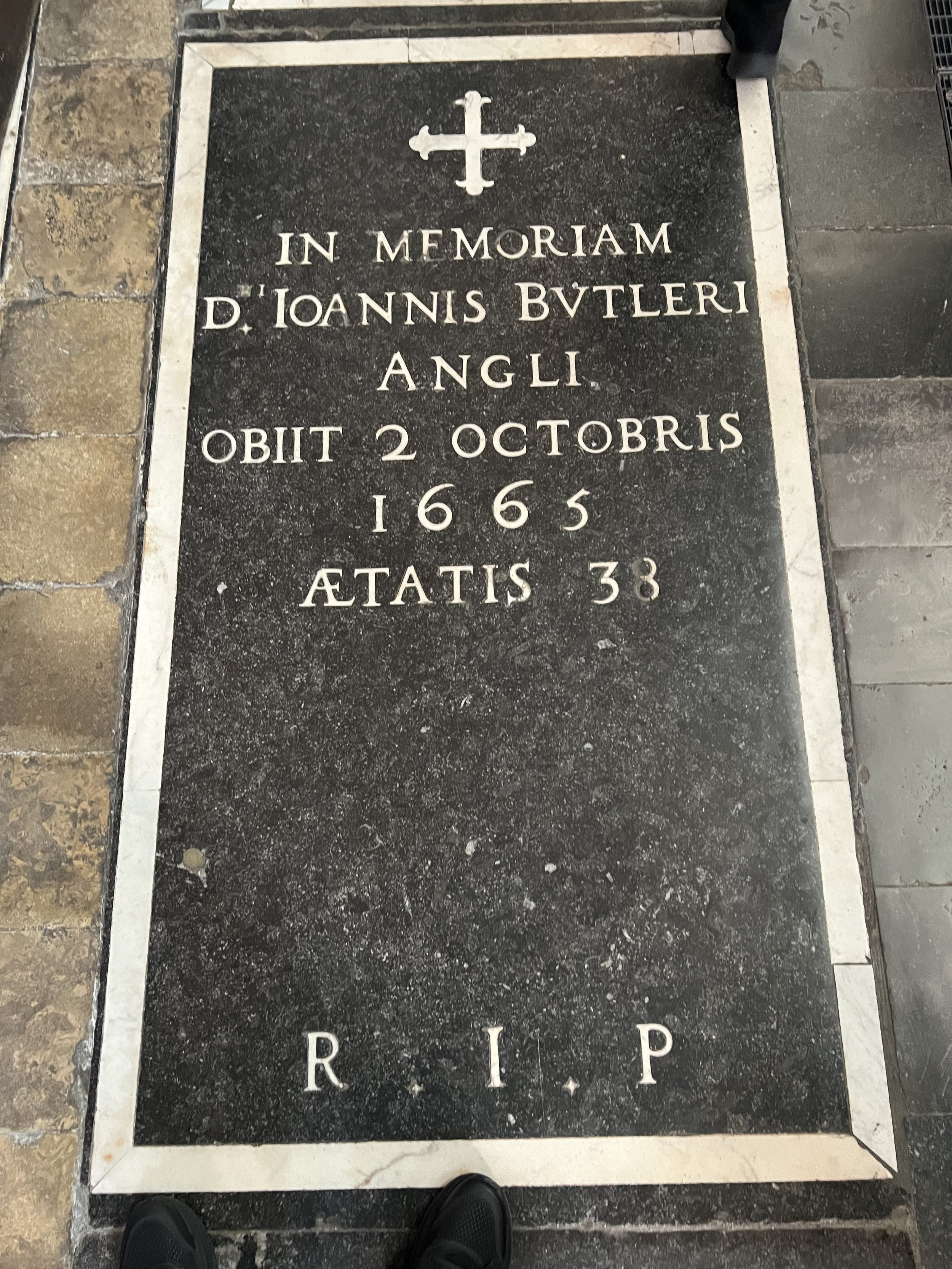
This practice of burial inside churches, known as intramural burial, includes being buried underneath the church floor, as shown in the accompanying picture. As noted above, this practice was largely reserved for elites, combining religious beliefs, social hierarchy, and economic status. Often, wealthy patrons endowed chantries or paid for masses (or other patronage such as donations of money and land) to be conducted for their souls. In summary, people were buried inside churches because they believed there was a spiritual proximity to the sacred (being closer to God and to receive intercessory prayer), status, honor, and public memory (visible markers of rank or status, prestigious, prime locations near the altar), regular remembrance and prayers from the living, and family lineage (Note 8).
Which leads us to ponder the question: Did the rich think they could buy their way into heaven? Secondly, are there people today who believe heaven is a place that can be purchased?
The story of the stinking rich
I’ve mentioned in previous posts that I consider wealth to come in various forms, and I’ve defined those earlier in this post. These include wealthy (what we all want to be) and rich. Rich comes in various levels, such as a little rich, somewhat rich, and stinking rich. If you would like to read more about these various terms, check out my posts of April 8, 2025, titled Your Financial Path-Rich or Wealthy, or March 30, 2026, titled Life Lessons from My Carpet Cleaning Guy. All are available under the Blog tab on my website; just scroll down until you get back to those dates.
Which brings us to the question of where the term “the stinking rich” came from. Here’s the short answer: We don’t know. There is, however, some evidence to suggest that, perhaps as in our story today, the rich were entombed in vaults in the church that were not airtight. Over time, as the bodies decayed, an odor began to waft throughout the church, resulting in the term “the stinking rich.” Some suggest this is the lore of European tour guides, and this could be true too. In fact, our tour guide from that day even made the comment. Regardless, I think we all get the point that the rich used their money to buy influence, even, perhaps, thinking they could buy their way into heaven. Some things never change, eh? Which is why at Afterburner Success Partners, we never want anyone to be rich, just wealthy.
The important point
I hope no one thinks they can buy their way into heaven. In fact, there is only one way to get into heaven and eternity with our Savior, and it’s a simple process that is a result of our faith. I’d like to offer four links that would be helpful to you as you ponder this:
https://www.gotquestions.org/how-can-I-be-saved.html
https://www.gotquestions.org/steps-to-salvation.html
https://www.gotquestions.org/what-must-I-believe-to-be-saved.html
https://www.gotquestions.org/need-to-be-saved.html
Summary
I hope I have piqued your interest in church history a little bit today. Perhaps you found the story of the stinking rich amusing. We’ve all used the term for many years, but how many of us really know where it comes from? But most importantly, I hope that if you are not saved, I’ve piqued your interest in that as well and hope you will consider that heaven can’t be bought, but it can be yours for free. It’s a free gift of grace.
That’s all for today!
Let’s help our friends and loved ones, shall we?
If you find the information in this post useful or enjoyable, please forward it to those you care about.
Then, simply say, “Search the internet for Afterburner Success Partners
to learn how to achieve your dreams and live your best life!”
The Stinking Rich?
Afterburner Success Partners
What’s in it for Me
Today we discussed perhaps the most important decision you will ever make in your life. One that will last for eternity.
Call to Action
What do you need to do today?
Recommended Resources
Buy and read Achieve Your Dreams: A Complete Guide to Live Your Best Life by David Giustozzi (Note 9). Take the course, it’s a very inexpensive investment in yourself.
Up Next
Back to regular posting schedule.
Notes
Please note that as an Amazon Affiliate, I may earn a small commission on the sale of any of these recommended resources.
Our Lord in the Attic Museum: https://opsolder.nl/en/museum-our-lord-in-the-attic/
Timeline of the Catholic Church: https://en.wikipedia.org/wiki/Timeline_of_the_Catholic_Church
A Concise History of The Roman Catholic Church, learnreligions.com: https://www.learnreligions.com/roman-catholic-church-history-700528
What was the Protestant Reformation?, gotquestions.org: https://www.gotquestions.org/Protestant-Reformation.html
The History of the Bible, Christianity.org.uk: https://www.christianity.org.uk/article/the-history-of-the-bible
What is the Latin Vulgate Bible?, gotquestions.org: https://www.gotquestions.org/Latin-Vulgate.html
Why are the protestant, Catholic, and Orthodox Bibles different?, Bible gateway blog: https://www.biblegateway.com/blog/2022/04/why-are-protestant-catholic-and-orthodox-bibles-different/
I use ChatGPT AI for a lot of my research, but I always validate it by referencing the sources of those search results. Various sources were used, such as books including: The Hour of our Death by Philippe Aries, Death in the Middle Ages by Sharon Farmer, and numerous others. I also received personal education by visiting these churches and learning the stories for myself.
Achieve Your Dreams: A Complete Guide to Live Your Best Life by David Giustozzi: https://amzn.to/3IxEFgy
Everyday Cooking for Everyday People Like Us, by David Giustozzi: https://amzn.to/437OhVQ