Homeostasis: A Medical Condition? Or Maybe It’s Just Us
Homeostasis is an interesting word. It means a state of balance. It’s also why we resist change.
An off schedule post
This is an off-schedule post. That means something different or interesting is going on that warrants paying attention to. So, my friends, read on to find out more!
Introduction
I’m going to ask for a little bit of liberty here. A little slack, some grace. Can you give that to me? Because what I’m doing here, like I often do, is taking something that occurs in our everyday life and making an analogy out of it and telling a story. I’m being a little creative. So we can learn from it. And do better. And that’s what we all want. Why? So we can achieve our dreams and live our best life! Yes. That’s it!
Homeostasis from a medical perspective
Homeostasis is how our body regulates itself so that all the internal systems function correctly. It comes from two Greek words meaning equal and holding still. In other words, it’s a state of balance. It’s about everything our bodies need to function properly, being regulated and balanced (Note 1). I think we all can understand and relate to this. A simple example is that when our body temperature is balanced, it’s about 96.8 degrees. When we run a fever, it’s just a few degrees higher, and it can not only make us feel bad but also be dangerous to our health. The same with our heart rate, breathing or blood oxygen levels.
You can click on the link to the Cleveland Clinic in Note 1 to learn more about the medical definition of homeostasis, but what I really want to talk about is another meaning of the term.
The resistance to change
As humans, we are creatures of habit, and as such, we tend, naturally, to resist change. Like our bodies want to remain in a constant state. We tend to do the things that make us feel good, secure and comfortable. Whether our current state is beneficial or not, we tend to want to keep doing the same thing. Inertia tends to keep us on the same path, doing the same thing. And when we do have the desire and motivation to change, our bodies, through homeostasis, tend to fight us and remain in the current balanced state. But it’s a bit worse. Our brain tends to resist change as well, and our basal ganglia, the primitive brain responsible for “wiring” our habits, tend to keep us on automatic or routine behaviors, especially those that make us feel good. This would include things such as smoking, nail biting, and the like. If we’ve been doing it, it’s hard to stop doing it.
While we can consciously choose to work out, this decision-making is controlled by the neocortex, the part of the brain that governs decision-making. Conscious actions require much more effort than unconscious ones. And that goes for all of us run-of-the-mill humans. Worse, if one suffers from a mental disorder, this can make change more difficult (Note 2). I’m guessing you are starting to see the problem.
Homeostasis and why we backslide
I often recommend books, and here is a recent read of mine that I think you'll enjoy. Mastery by George Leonard has the subtitle The Keys to Success and Long-Term Fulfillment (Note 3). This book is a short, easy read, but it is full of information to help you learn the keys to mastering the subjects you want to be an expert in. In the author’s case, he is an expert at Aikido, a Japanese martial art focused on self-defense. This book is similarly themed to two recent books I mentioned and advocated for, Chop Wood, Carry Water and Pound the Stone, both by Joshua Medcalf (Note 4, 5). In each of these books, we are taught that the real satisfaction lies in the journey, the practice, and the participation. Reaching the goal? Well, that will come. In due time. In a long time. Because, you see, it’s the journey where the real learning takes place, and we are taught to enjoy the journey. Or as I say, we want to smell the roses along the way. We embrace these same principles at Afterburner Success Partners. Achieving your dreams is a journey to be enjoyed along the way. It’s a slow, deliberate process.
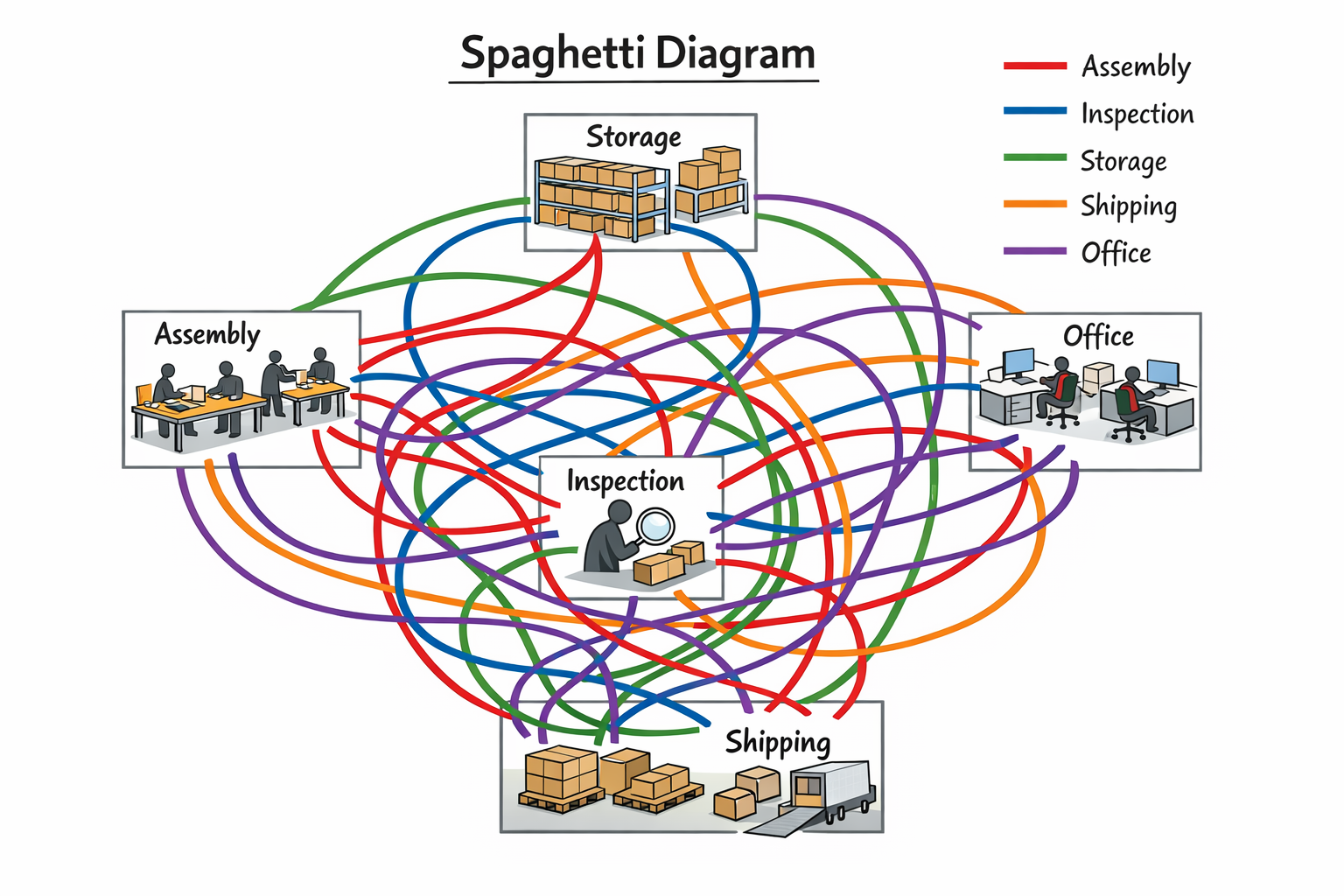
Anyway, reading all these books will help you on your journey. In chapter 10 of Mastery, Mr. Leonard helps us understand why change is so hard, and he explains homeostasis in simple terms we all understand. Now, lest you think change is hard for an individual, try a major organizational change or governmental change. As a LEAN/Six Sigma practitioner throughout my career, I had to keep relearning the lesson that organizations really don’t want to change, no matter how much the employees do. Government? Well, I really don’t need to say anything about that, do I? What’s really interesting is that if you were to take the time to map out a process, you would likely see that it’s quite inefficient. For example, the picture is one of what is called a spaghetti diagram, and what this diagram does is literally trace every step needed to complete a function. In this case, a manufacturing process. And when you have finished, you will see the result of all that tracing: a bunch of pencil marks that look like a pile of spaghetti. Yes, confusing. But you could do the same at home. You could map out your process of getting ready for work, paying the bills, or fixing dinner. If you were to be honest with yourself, you would probably learn there is a better way. But even if you found a better way, your natural tendency is to continue doing what you have been because you are wired that way and it’s familiar. This is our problem.
When we attempt to change something, a natural tendency is to backslide, that is go back to what we were doing, whether it was good or bad. And what is Mr. Leonard’s answer to backsliding? It’s simple. When you commit to mastery of a subject (as opposed to saying you want to change, or worse, a New Year’s resolution), you commit yourself to the principles of mastery (which he describes in the book) which is were the beneficial change happens. Yeah, just buy the book, it will help you… When you commit yourself to mastery in one subject (in his case, Aikido), you will find that there are spin-off benefits in other subjects that occur along the way as well. Some of the big reasons for failing to change include self-sabotage and resistance from family, friends, and coworkers. Mr. Leonard offers five guidelines to help you overcome these issues, this resistance to change and subject mastery:
Be aware of how homeostasis works.
Be willing to negotiate with your resistance to change
Develop a support system
Follow regular practice
Dedicate yourself to lifelong learning
Do any of these things sound familiar? I hope so, because the last three are directly related to the principles we use at Afterburner Success Partners, and the first two are general concepts we use as well, although not directly.
Overcoming obstacles to our goals
Whether it’s losing weight or any other desired change, we should recognize that we have an inherent resistance to change. Forcing ourselves to commit to certain behaviors may increase our chances of success. Frequent exercise and conscious action planning, for example, help these new habits stick, and we must overcome behavioral inertia, a subconscious force that resists change (Note 2). Getting started is the hardest part; we know that, and we’ve all heard that it takes about 66 days for a new habit to take hold. And this is why your New Year’s resolution has been abandoned by mid February.
My takeaway from all of this is that yes, change is hard, we all tend to resist it, and it’s difficult for anyone. As Mr. Leonard advocates, don’t just commit to change, commit to mastery of your subject matter. That commitment to mastery is on a completely higher plane than just saying I want to change. Or I’m going to make a New Year’s resolution, which we know does not work.
Summary
Well, I learned a few things in writing this post. I hope you did as well. You know, I keep learning a lesson I learned many years ago, and it’s a simple little saying: “The more things change, the more they stay the same.” What that means can be summed up in a few examples. When mom told us to wear a hat, I never understood that we lose more heat from our head than anywhere else, but mom knew and she was right. When I worked with my daughter on her spelling words from Monday through Thursday, I knew she would do well on her test on Friday because repetition is the best way to study and learn. I knew it, but she did not. I hoped she would learn the relationship between studying, repetition, and good grades (she did). You get the point: Good habits result in good results.
The more things change, the more they stay the same is a phrase coined by Frenchman Jean-Baptiste Alphonse Karr in his journal Les Guepes in January 1849. What he meant is that despite significant transformation, fundamental aspects of human nature, situation, or reality often remain unchanged, reflecting recurring patterns. (Note 6). And, as you know, it’s often used sarcastically to describe a particular irony.
So, what we learned today is, in essence, what we always knew, except now we know why. Change is hard; it always has been, and it always will be, because our bodies and brains naturally resist change. Overcoming this natural resistance is an exercise in willpower and endurance. Do it for 67 days, and you will have most likely made your change a new habit.
Are there any changes you need to make? Then set your mind to it and get after it!
That’s all for today!
Let’s help our friends and loved ones, shall we?
If you find the information in this post useful or enjoyable, please forward it to those you care about.
Then, simply say, “Search the internet for Afterburner Success Partners
to learn how to achieve your dreams and live your best life!”
Change is hard. Even when we know we can do better
Afterburner Success Partners
What’s in it for Me
We must always be aware of our knowledge related to what we want to do and ensure what we think we know is true. Then, we must act in a determined manner. Doing so will ensure we get what we want, and that’s what’s in it for me.
Call to Action
Honestly consider if you need to make some changes. Or, perhaps you may want to learn a few things. Purchase any of the books noted below. Take the Afterburner Success Partners course. Tell a friend.
Recommended Resources
Buy and read any of the books mentioned in the notes below.
Up Next
Back to regular posting schedule.
Notes
Please note that as an Amazon Affiliate, I may earn a small commission on the sale of any of these recommended resources.
Homeostasis, The Cleveland Clinic: https://my.clevelandclinic.org/health/articles/homeostasis
Why We Resist Change, Psychology Today, January 25, 2017: https://www.psychologytoday.com/us/blog/the-truisms-of-wellness/201701/why-we-resist-change
Mastery by George Leonard: https://amzn.to/4jQv2I8
Chop Wood, Carry Water by Joshua Medcalf: https://amzn.to/4aD9GeK
Pound the Stone by Joshua Medcalf: https://amzn.to/3MnrCA1
The More Things Change, Wikipedia: https://en.wikipedia.org/wiki/Jean-Baptiste_Alphonse_Karr
Everyday Cooking for Everyday People Like Us, by David Giustozzi: https://amzn.to/437OhVQ
Achieve Your Dreams: A Complete Guide to Live Your Best Life by David Giustozzi: https://amzn.to/3IxEFgy